-
Shop
- Advanced Technologies
- AI Skills for Creators & Freelancers
- AI Client Management
- AI Ethics
- AI Mindset
- AI Tools & Prompts
- AI Writing & Content Creation
- Audio, Voice & Music
- Design & Visual Creation
- Email, Messaging & Communication
- Freelancing & Business
- Marketing, Ads & Conversion
- Productivity, Workflow & Automation
- SEO & Search Optimization
- Social Media Content & Growth
- Strategy, Planning & Analytics
- Video Creation & Editing
- AI Skills Mastery 2026 Collection
- Bathroom
- Best-Sellers
- Car Accessories
- Confidence
- Dating & Social Skills
- Digital Resources
- Easter Products
- Education & Learning
- Family & Parenting
- Fashion
- Fashion Accessories
- Furniture
- Gadgets
- Health & Beauty
- Health & Wellness
- Home & Garden
- Home Electronics
- Home Supplies
- Jewelry
- Kids & Babies
- Kitchen
- Lighting
- Patio, Lawn & Garden
- Personal Growth
- Pet Care
- Pet Supplies
- Pets
- Shoes
- Smart Home Living Guides
- Sport & Outdoors
- Stress Relief & Relaxation
- Super Deals
- TikTok Growth & Monetization Mastery
- Travel
- Travel & Adventure
- Wealth
- Wellness
30-Day Self-Discipline Challenge: Printable Habit Plan

The 30-Day Self-Discipline Challenge: A Printable Plan for Habits, Focus, and Follow-Through
A 30-day challenge works best when daily actions are small, trackable, and tied to a clear goal. A printable plan can act like a structured reset: define priorities, build consistency, and reduce decision fatigue with a simple daily framework that supports habits, focus, productivity, and goal setting. Instead of relying on “feeling motivated,” the goal is to make follow-through easier to repeat—especially on the days when energy is low.
What a 30-day self-discipline challenge is (and what it isn’t)
A 30-day self-discipline challenge is a short, time-bound commitment that prioritizes consistency over intensity. Think of it as a practice block: you’re training follow-through the way you’d train a skill—by showing up with a clear plan, even when it’s not perfect.
- A daily system for smaller promises: You set commitments that are easier to keep, which builds trust in your own routines.
- Not a punishment plan: Sustainable discipline avoids extremes and relies on clear rules and recovery—sleep, reasonable workloads, and clean stopping points.
- Repeatable and adaptable: After day 30, you can run the same structure again with a higher minimum or a new goal.
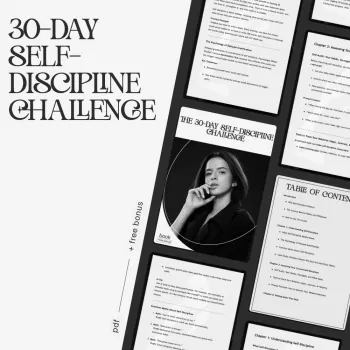
If you want a simple, ready-to-print structure, the The 30-Day Self-Discipline Challenge | Printable Motivation eBook is designed to keep the daily decision-making light while making progress easy to see.
How the printable challenge supports habits, focus, productivity, and goals
The most effective discipline plans reduce “thinking overhead.” When the next step is obvious, it takes less willpower to begin. This is closely aligned with behavior design principles that emphasize making actions easier to start and repeat (see the Stanford Behavior Design Lab).
- Habit building: Choose one primary habit and one support habit (sleep, hydration, planning). Fewer targets reduce decision fatigue and raise consistency.
- Focus training: Use a single daily focus block and a short list of priority tasks to prevent “attention leaks.”
- Productivity without burnout: Track outputs (sessions completed, pages written, workouts done) rather than vague effort.
- Goal setting: Tie daily actions to a measurable 30-day outcome (hours practiced, lessons finished, decluttered spaces completed).
- Motivation that lasts: Visible progress makes the work feel rewarding, reducing dependence on willpower spikes—an idea echoed in habit fundamentals popularized by Atomic Habits.
Set up your challenge in 15 minutes
A strong setup makes day-to-day execution simpler. Keep the plan small enough to start immediately, but specific enough to measure.
- Pick one main outcome for 30 days: “Complete 20 focus sessions” or “Cook dinner at home 18 times.”
- Choose a daily minimum that still counts on hard days: 10 minutes, 1 page, 1 small task.
- Define 3 rules that remove ambiguity: Example: “Phone stays out of reach during focus block,” “No skipped planning day,” “If missed, restart the next day—no doubling up.”
- Identify friction points: Time, energy, environment—then pre-plan one fix for each.
- Decide tracking: Mark daily on a printed page, or print weekly sheets and review every Sunday.
Quick challenge blueprint (copy to your first page)
| Element | Fill-in guide | Example |
|---|---|---|
| Main 30-day outcome | Measurable result by day 30 | Finish 10 lessons in a course |
| Daily minimum | Smallest valid effort | 15 minutes study |
| Focus block | Start time + duration | 7:30–8:00 PM |
| 3 rules | Simple, enforceable boundaries | No social apps before the block |
| Weekly review | One time to adjust | Sunday 20 minutes |
| Reward | Non-destructive reinforcement | New book after day 30 |
Daily structure: the 5-minute discipline loop
This loop is designed to lower the “start cost” and close the day with a tiny review—so tomorrow is easier.
If distraction is the main obstacle, consider physically moving your phone away during your focus block—or making it harder to grab quickly. For example, a dedicated driving-only setup like the Universal Car Steering Wheel Phone Mount for Safe Navigation can help keep “phone use” more intentional outside work sessions by separating navigation time from scrolling time.
Common obstacles—and simple fixes that keep the streak alive
Self-control is easier when the environment supports it, not when you’re constantly resisting temptation. (For a concise definition, see the APA Dictionary of Psychology: Self-control.)
How to use the printable pages for accountability
Small tools can also reduce friction around routines. If your habit is “clean up and reset the bathroom nightly,” an easy-to-use item like the Triple-Sided Ultra-Fine Soft Bristle Toothbrush for Enhanced Oral Health can make the routine feel simpler and faster—helping the habit stay consistent rather than perfect.
Who this challenge fits best
Get the printable challenge
If you want a ready-to-print structure that keeps daily actions clear and trackable, start with The 30-Day Self-Discipline Challenge | Printable Motivation eBook. It’s built to support habit consistency, distraction control, and realistic progress—and it works as a repeatable template you can run again with a new habit or a higher daily minimum after day 30.
FAQ
What if a day is missed—does the challenge fail?
No. Resume the next day without doubling up, and use the daily minimum to reduce the chance of another skip. Aim for total completed days over a perfect streak.
How many habits should be tackled during 30 days?
One primary habit plus one supportive habit at most. Fewer targets reduce decision fatigue and make it more likely you’ll follow through consistently.
How long should the daily focus block be?
Start with 10–45 minutes depending on your current capacity, then increase only after a week of consistency. A smaller block you actually repeat beats an ambitious block you avoid.
Recommended for you

Was this article helpful?
Yes
No









Leave a comment