-
Shop
- Advanced Technologies
- AI Skills for Creators & Freelancers
- AI Client Management
- AI Ethics
- AI Mindset
- AI Tools & Prompts
- AI Writing & Content Creation
- Audio, Voice & Music
- Design & Visual Creation
- Email, Messaging & Communication
- Freelancing & Business
- Marketing, Ads & Conversion
- Productivity, Workflow & Automation
- SEO & Search Optimization
- Social Media Content & Growth
- Strategy, Planning & Analytics
- Video Creation & Editing
- AI Skills Mastery 2026 Collection
- Bathroom
- Best-Sellers
- Car Accessories
- Confidence
- Dating & Social Skills
- Digital Resources
- Easter Products
- Education & Learning
- Family & Parenting
- Fashion
- Fashion Accessories
- Furniture
- Gadgets
- Health & Beauty
- Health & Wellness
- Home & Garden
- Home Electronics
- Home Supplies
- Jewelry
- Kids & Babies
- Kitchen
- Lighting
- Patio, Lawn & Garden
- Personal Growth
- Pet Care
- Pet Supplies
- Pets
- Shoes
- Smart Home Living Guides
- Sport & Outdoors
- Stress Relief & Relaxation
- Super Deals
- TikTok Growth & Monetization Mastery
- Travel
- Travel & Adventure
- Wealth
- Wellness
Multi-Tasking Room Makeover Checklist for Small Spaces
The Multi-Tasking Room Makeover Plan: A Printable Checklist for Small Spaces, Smart Storage, and Flexible Rooms
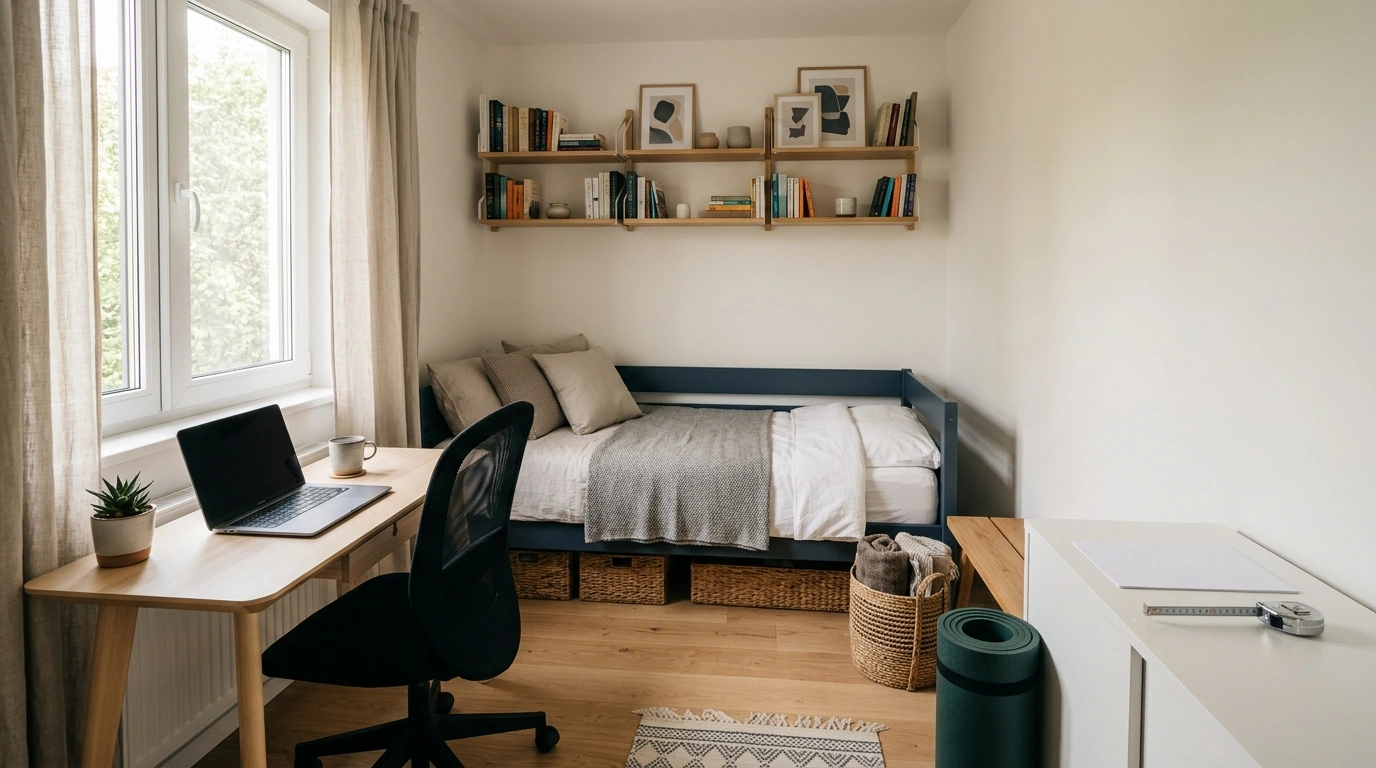
Multi-purpose rooms stay peaceful when each activity has a clear “home,” surfaces are easy to reset, and storage supports quick transitions. Instead of trying to perfect everything at once, this makeover plan uses a few simple passes—measure, zone, store, and reset—so a home office can become a guest room, a studio can double as a workout nook, and a small space can feel calm even when it does more than one job.
Start with the room’s top 2–3 jobs (and define what “ready” looks like)
Flexibility starts with clarity. Pick the room’s primary and secondary functions, then decide what “ready” means for each one.
- Choose the top 2–3 functions. Examples: work + guest, studio + storage, craft + family drop zone.
- Write a one-sentence “ready state” for each job. Example: “Desk clear, laptop docked, cables hidden,” or “Bed made, nightstand empty, linens accessible.”
- List what must stay within arm’s reach. Anything not on the list becomes stored, mobile, or off-site.
- Pick a reset time target. Five minutes is ideal for daily switching; 15 minutes works well for weekly switching.
If you want the steps in a single, printable flow, keep The Multi-Tasking Room Makeover Plan printable checklist inside a closet door or desk drawer so you’re not re-deciding the process every time the room changes modes.
Measure, map, and choose zones that don’t fight each other
Multi-functional rooms feel frustrating when zones overlap in a way that forces constant moving and re-moving. A quick measurement pass prevents that.
- Measure the constraints: wall lengths, window/door swing, closet depth, and radiator/vent clearance.
- Map three zone types:
- Active zone: where the task happens (desk, workout mat, craft table).
- Support zone: where supplies live (cabinet, closet shelf, rolling cart).
- Reset zone: an empty surface or clear floor space used to switch modes.
- Place light and noise wisely: keep the noisiest/brightest function near natural light; keep the restful function away from screen glow and task-light glare.
- Use vertical space to protect the reset zone: wall storage and tall cabinets keep floors and tabletops open.
If your room includes a desk setup, a quick ergonomics check helps reduce strain in tight quarters. The CDC’s ergonomics guidance is a useful reference for aligning your work zone with comfort basics: https://www.cdc.gov/niosh/topics/ergonomics/.
Smart storage rules for multi-functional rooms
The right storage style makes a flexible room feel intentional instead of “in progress.” Use these rules to keep transitions fast and visual clutter low.
Zone + storage matchups for rooms that change functions
| Room setup | Best storage types | What to store | Reset tip |
|---|---|---|---|
| Home office + guest room | Under-bed bins, closet shelf bins, lidded baskets | Guest linens, spare pillows, paper refills | Keep a “guest-ready” bin labeled and always complete |
| Studio + home office | Drawer units, vertical file box, rolling cart | Tools, cables, notebooks, camera/art supplies | End each session by returning the cart to its parking spot |
| Workout + guest room | Tall cabinet, over-door hooks, folding crate | Bands, mat, towels, slippers | Store soft goods in one lidded bin to avoid visual clutter |
| Craft + family drop zone | Wall rail, labeled bins, shallow trays | Mail, scissors, tape, project kits | Use a tray for incoming items; empty it nightly |
A room-by-room mini plan: home office, guest room, and studio needs
For guest-ready details that reduce last-minute scrambling, keep a small hygiene refill tucked into your guest kit. A compact option like the Triple-Sided Ultra-Fine Soft Bristle Toothbrush for Enhanced Oral Health works well as a backup item for visitors.
The printable checklist flow: declutter, containerize, label, and reset
If you want additional practical guidance on keeping household systems manageable, the University of Minnesota Extension offers helpful organizing principles you can adapt to small, multi-use rooms: https://extension.umn.edu/inside-extension/organizing-your-home.
Common trouble spots (and quick fixes that keep the room flexible)
For households that use the room as a drop zone too, consider a dedicated spot for quick grab-and-go setup—especially if you frequently navigate errands between work blocks. The Universal Car Steering Wheel Phone Mount for Safe Navigation can live near keys/charging so your transition out the door is as smooth as your room reset.
Printable plan to keep on hand for quick room resets
FAQ
How can a home office convert to a guest room quickly without feeling cluttered?
Use closed storage for office supplies, keep guest items together in one labeled bin, and protect a clear reset surface. A short end-of-day routine (clear desk, stash cables, return supplies to the same kit) makes guest mode feel intentional and fast.
What’s the best way to organize storage in a room with two functions?
Store by task in complete kits, give each kit a container limit, and keep daily-use items one-touch accessible. Use vertical and under-furniture storage to protect open floor space so switching modes doesn’t require a full room shuffle.
How do labels stay useful over time?
Use simple category names, label both the front and top of containers, and do a quick monthly review to prevent overflow. When a bin starts to overfill, edit the contents before you add anything new.
Recommended for you


Was this article helpful?
Yes
No









Leave a comment