-
Shop
- Advanced Technologies
- AI Skills for Creators & Freelancers
- AI Client Management
- AI Ethics
- AI Mindset
- AI Tools & Prompts
- AI Writing & Content Creation
- Audio, Voice & Music
- Design & Visual Creation
- Email, Messaging & Communication
- Freelancing & Business
- Marketing, Ads & Conversion
- Productivity, Workflow & Automation
- SEO & Search Optimization
- Social Media Content & Growth
- Strategy, Planning & Analytics
- Video Creation & Editing
- AI Skills Mastery 2026 Collection
- Bathroom
- Best-Sellers
- Car Accessories
- Confidence
- Dating & Social Skills
- Digital Resources
- Easter Products
- Education & Learning
- Family & Parenting
- Fashion
- Fashion Accessories
- Furniture
- Gadgets
- Health & Beauty
- Health & Wellness
- Home & Garden
- Home Electronics
- Home Supplies
- Jewelry
- Kids & Babies
- Kitchen
- Lighting
- Patio, Lawn & Garden
- Personal Growth
- Pet Care
- Pet Supplies
- Pets
- Shoes
- Smart Home Living Guides
- Sport & Outdoors
- Stress Relief & Relaxation
- Super Deals
- TikTok Growth & Monetization Mastery
- Travel
- Travel & Adventure
- Wealth
- Wellness
Montessori Floor Bed with Fence: Safe, Independent Sleep
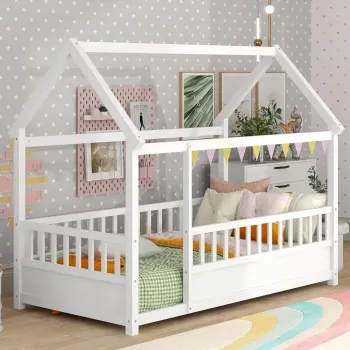
Montessori Floor Bed with Fence: A Practical Setup for Independent Sleep
A Montessori-style floor bed paired with a surrounding fence helps create a clear, toddler-height sleep zone while supporting independent movement. For many families, the goal is simple: a child can climb in and out on their own, practice body awareness, and settle with fewer “rescue” transfers—without losing the sense of a defined bedtime boundary. Below is a practical guide to deciding if a fenced floor bed fits your home, how to set it up safely, and which design details make daily use easier.
What a Fenced Floor Bed Is (and Why Families Choose It)
A fenced floor bed is a low-to-the-ground bed frame designed to hold a mattress near floor level, with a perimeter fence that outlines the sleep surface. Unlike a traditional bed with open sides, the fence provides a visible boundary that can make the bed feel like a dedicated “sleep space,” especially in busy or shared rooms.
Families often choose this setup to support self-directed bedtime routines. When a child can climb in and out independently, they’re able to respond to normal wake-ups (repositioning, finding a comfort item, returning to bed) without needing to call for help immediately.
The fence can also help with rolling safety and with visually separating sleep from play. For the best results, it’s typically paired with an uncluttered room layout and consistent sleep cues—dim light, steady noise level, and a predictable wind-down routine.
When a Floor Bed with Fence Can Be a Good Fit
A fenced floor bed can work well for toddlers transitioning from a crib, particularly when they can safely get down to the floor and back up—and when the room is fully childproofed. It’s also a common choice for children who strongly resist confinement but settle better with freedom of movement plus a clear boundary.
In smaller bedrooms, the low profile can make the room feel more open than a bulky crib or tall frame. Many caregivers also like that a child can access a small set of books or a soft comfort item during wind-down, as long as reachable items stay minimal and safe.
Safety and Room Setup Essentials
The most important mindset shift is this: treat the whole room like the “crib.” The fence outlines the sleep surface, but it doesn’t make the rest of the room automatically safe. Start by securing furniture to the wall, covering outlets, managing cords and blind strings, and removing tip hazards.
Keep the area around the bed clear. Avoid heavy shelves or wall décor directly above the sleep space. Confirm the fence spacing and overall design don’t create entrapment risks, and avoid improvised add-ons that change gaps or rigidity. For safe-sleep guidance, review the American Academy of Pediatrics safe sleep recommendations, and for general information on gaps and entrapment hazards, see the CPSC crib safety tips.
Room Checklist for a Toddler-Accessible Sleep Space
| Item | What to Do | Why It Matters |
|---|---|---|
| Furniture anchoring | Anchor dressers/bookcases; keep heavy items low | Reduces tip-over risk |
| Cords & blinds | Shorten/secure cords; use cordless solutions when possible | Prevents strangulation hazards |
| Outlet & edge protection | Cover outlets; pad sharp corners nearby | Limits common bumps and access risks |
| Floor area | Clear clutter; avoid small objects; add a low-pile rug if needed | Prevents choking hazards and slips |
| Bed zone | Keep a small, soft comfort item only; avoid heavy blankets for younger toddlers | Supports safer sleep environment |
Key Design Features to Compare
Not all fenced floor beds function the same in real life. Fence height should be high enough to help with rolling containment, while still allowing easy caregiver access for bedtime support. If the fence is too low relative to the mattress, it may not serve its purpose; if it’s too high, it can feel awkward for story time or middle-of-the-night checks.
Next, look at the gate or entry. Some frames have a dedicated opening; others use a removable section. Consider how it latches (or whether it’s fixed open) and whether the entry aligns with your room layout—especially if you’re working around a door swing, closet access, or a shared wall.
Mattress Sizing and Fit
Daily Use: Making Bedtime Independence Work
Care, Cleaning, and Longevity
A Ready Option to Consider
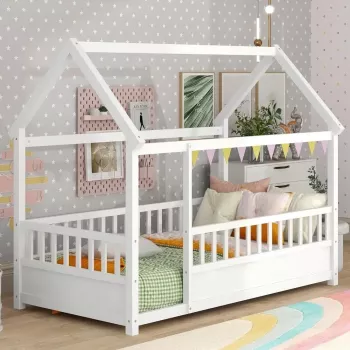
If you’re looking for a dedicated fenced frame designed to define a toddler-height sleep space, the Montessori Floor Bed with Fence is a straightforward option to compare against your room plan. It’s best used with a properly fitting, firm mattress and a fully childproofed room.
Before ordering, confirm your room dimensions and preferred entry orientation so the opening works with the layout. For a few extra household essentials many families keep on hand during transitions, you can also browse the Triple-Sided Ultra-Fine Soft Bristle Toothbrush for Enhanced Oral Health and the Universal Car Steering Wheel Phone Mount for Safe Navigation.
FAQ
What age is appropriate for a floor bed with a fence?
It depends more on readiness than a single age: the child should be mobile enough to get in and out safely and able to follow simple boundaries. The room must be fully childproofed, and families should follow pediatric safe-sleep guidance for infants and young toddlers.
Does a fenced floor bed replace childproofing the room?
No. The fence only defines the sleep surface; the entire room still needs to be treated like a safe sleep environment with anchored furniture, secured cords, covered outlets, and minimized hazards.
How do you choose the right mattress thickness for a fenced floor bed?
Choose a firm mattress that fits the frame closely with minimal gaps, then consider thickness in relation to fence height—too thick can reduce the fence’s effective containment. Avoid toppers or overly soft layers that can shift and create uneven surfaces.
Recommended for you
Was this article helpful?
Yes
No









Leave a comment