-
Shop
- Advanced Technologies
- AI Skills for Creators & Freelancers
- AI Client Management
- AI Ethics
- AI Mindset
- AI Tools & Prompts
- AI Writing & Content Creation
- Audio, Voice & Music
- Design & Visual Creation
- Email, Messaging & Communication
- Freelancing & Business
- Marketing, Ads & Conversion
- Productivity, Workflow & Automation
- SEO & Search Optimization
- Social Media Content & Growth
- Strategy, Planning & Analytics
- Video Creation & Editing
- AI Skills Mastery 2026 Collection
- Bathroom
- Best-Sellers
- Car Accessories
- Confidence
- Dating & Social Skills
- Digital Resources
- Easter Products
- Education & Learning
- Family & Parenting
- Fashion
- Fashion Accessories
- Furniture
- Gadgets
- Health & Beauty
- Health & Wellness
- Home & Garden
- Home Electronics
- Home Supplies
- Jewelry
- Kids & Babies
- Kitchen
- Lighting
- Patio, Lawn & Garden
- Personal Growth
- Pet Care
- Pet Supplies
- Pets
- Shoes
- Smart Home Living Guides
- Sport & Outdoors
- Stress Relief & Relaxation
- Super Deals
- TikTok Growth & Monetization Mastery
- Travel
- Travel & Adventure
- Wealth
- Wellness
Magnetic Pipe Track Set: Fast Rebuild Marble Runs
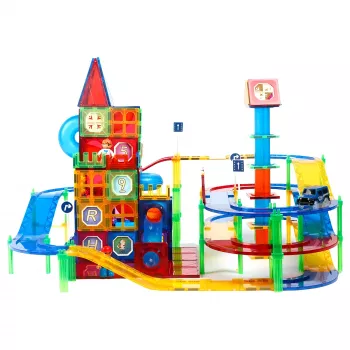
Magnetic Pipe Track Building Set: Marble-Run Builds with Lights, Curves, and Fast Rebuilds
A magnetic pipe track set combines snap-together magnets with translucent tubes and ramps to create rolling-ball runs that can be rebuilt in minutes. It’s a hands-on way to explore cause-and-effect, speed, and gravity while keeping setup frustration low and creativity high.
What Makes a Magnetic Pipe Track Set Different
Classic marble runs and open-track raceways can be fun, but they often come with two common issues: alignment hassles and rebuild fatigue. Magnetic pipe track sets tackle both by making connections feel more guided and secure, while the pipe-style geometry helps the ball stay on course.
- Magnetic connections reduce misalignment: pieces guide into place and hold during play, so a tall section is less likely to drift and collapse after a bump.
- Pipe-style tracks add enclosed sections, curves, and drops: the ball stays “captured,” which can make motion more predictable than open rails—especially on steeper slopes.
- Translucent components make the motion visible: kids can literally watch what’s happening inside the tubes, which makes it easier to notice where speed changes or where a jam begins.
- Fast rebuilds encourage iteration: swapping one curve or adding a support can change the whole run, so experimentation feels natural instead of time-consuming.
Skills It Helps Build (Without Feeling Like a Lesson)
The best building toys don’t feel like worksheets. A magnetic pipe track set tends to stay in the “play first” category because the payoff is immediate: build, roll, tweak, repeat.
- Spatial reasoning: planning routes, stacking supports, and visualizing a 3D path that still flows smoothly.
- Problem-solving: diagnosing stalls, jams, and slowdowns by adjusting angles, swapping a junction, or adding a stabilizer.
- Fine-motor practice: aligning magnets, snapping supports, and placing connectors precisely—especially when building upward.
- Early physics intuition: exploring momentum, friction, slope, and collision outcomes in a way that’s easy to see and test.
- Collaborative play: dividing tasks (base layout, towers, track tuning) helps groups build bigger, more reliable runs.
What to Look For Before Buying
Magnetic pipe track sets vary a lot in how sturdy they feel and how interesting the build options stay over time. A quick pre-buy scan can prevent the “cool once, then forgotten” outcome.
- Magnet strength and fit: pieces should resist twisting under the weight of stacked sections and hold alignment through repeated runs.
- Variety of track geometry: a mix of straight tubes, curves, and drops keeps builds from feeling repetitive.
- Stability parts: bases, pillars, or wide supports help tall builds stay upright on smooth floors.
- Ball compatibility: confirm the set’s balls are the intended size and material for the track diameter to reduce jams.
- Easy-to-clean surfaces: smooth plastics are simpler to wipe after floor play, especially if pieces travel between rooms.
Quick checklist
| Feature | Why it matters | What to check |
|---|---|---|
| Strong magnetic joins | Reduces collapses mid-run | Connections feel “snappy” and resist easy pull-apart |
| Curves + drops | Creates speed changes and fun transitions | Includes multiple bends, slopes, and vertical elements |
| Support pieces | Enables taller, steadier builds | Look for pillars/stands and broader base parts |
| Clear tubes | Makes troubleshooting easier | Balls remain visible through enclosed sections |
| Safety labeling | Adds confidence for kids’ use | Age guidance and consumer product safety info |
Build Ideas That Keep Play Fresh
When a set is quick to rebuild, it’s easy to turn “one run” into a mini challenge series. These ideas help maintain novelty without needing extra parts.
Safety, Age Fit, and Setup Tips
- Follow the manufacturer’s age guidance; small balls and small connectors can be choking hazards for younger children.
- Use on a flat surface; carpets can tilt towers and change run speed unpredictably.
- Keep magnets away from very young children and follow all warnings; swallowed magnets can be dangerous. For additional guidance, review the CPSC high-powered magnet safety information.
- Store balls in a closed container after play to prevent loss under furniture.
- Wipe pieces with a damp cloth and mild soap as needed; fully dry before storing.
For broader toy-safety context, many manufacturers reference standards such as ASTM F963.
Featured Set: Magnetic Pipe Track Building Set
If the goal is open-ended building that can be taken apart and rebuilt quickly, the Magnetic Pipe Track Building Set is designed around fast assembly and repeated experiments. The pipe-style sections support enclosed curves and drops, while the clear pieces make it easy to spot where a run loses speed.
Product snapshot
| Item | Details |
|---|---|
| Name | Magnetic Pipe Track Building Set |
| Price | $287.67 USD |
| Availability | In stock (limited quantity listed) |
| Product page | https://ulorin.com/magnetic-pipe-track-building-set/ |
More In-Stock Finds
- Triple-Sided Ultra-Fine Soft Bristle Toothbrush for Enhanced Oral Health
- Universal Car Steering Wheel Phone Mount for Safe Navigation
- Armani Exchange Men’s Sneakers
FAQ
What age is a magnetic pipe track set appropriate for?
Follow the age range listed by the manufacturer, since small balls, small connectors, and magnets may not be suitable for younger children. Supervision is important anytime small parts are in play.
Do magnetic track pieces work on carpet or only hard floors?
They can work on carpet, but a hard, level surface usually gives better stability and more consistent ball speed. Carpet can wobble towers and subtly change slopes, which increases stalls and tip-overs.
How can jams or slow spots in the track be fixed?
Start by smoothing transitions where a steep section meets a flatter one, and make sure curves are aligned without pinching. Adding a support under a joint and reducing abrupt angle changes often restores clean, repeatable runs.
Recommended for you


Was this article helpful?
Yes
No









Leave a comment