-
Shop
- Advanced Technologies
- AI Skills for Creators & Freelancers
- AI Client Management
- AI Ethics
- AI Mindset
- AI Tools & Prompts
- AI Writing & Content Creation
- Audio, Voice & Music
- Design & Visual Creation
- Email, Messaging & Communication
- Freelancing & Business
- Marketing, Ads & Conversion
- Productivity, Workflow & Automation
- SEO & Search Optimization
- Social Media Content & Growth
- Strategy, Planning & Analytics
- Video Creation & Editing
- AI Skills Mastery 2026 Collection
- Bathroom
- Best-Sellers
- Car Accessories
- Confidence
- Dating & Social Skills
- Digital Resources
- Easter Products
- Education & Learning
- Family & Parenting
- Fashion
- Fashion Accessories
- Furniture
- Gadgets
- Health & Beauty
- Health & Wellness
- Home & Garden
- Home Electronics
- Home Supplies
- Jewelry
- Kids & Babies
- Kitchen
- Lighting
- Patio, Lawn & Garden
- Personal Growth
- Pet Care
- Pet Supplies
- Pets
- Shoes
- Smart Home Living Guides
- Sport & Outdoors
- Stress Relief & Relaxation
- Super Deals
- TikTok Growth & Monetization Mastery
- Travel
- Travel & Adventure
- Wealth
- Wellness
Emotional Intelligence Skills to Calm Anxiety Fast

Calm & Clever: Mastering Emotional Intelligence to Tame Anxiety
Anxiety can feel like a runaway alarm system—loud, fast, and hard to reason with in the moment. Emotional intelligence (EI) offers practical, trainable skills to notice what’s happening internally, name it accurately, and respond in ways that create steadier calm over time. Instead of trying to “get rid of” anxiety on command, EI helps build a repeatable process: understand the signal, reduce the intensity, and choose the next helpful move.
For background on how common and treatable anxiety disorders are, see the National Institute of Mental Health (NIMH) and the American Psychological Association (APA).
Why emotional intelligence helps when anxiety spikes
Anxiety isn’t only a feeling. It’s a full-body-and-mind event: sensations (tight chest, stomach flips), thought patterns (what-ifs, worst-case forecasts), and action urges (escape, avoid, over-check). Emotional intelligence helps connect these pieces into a clear picture so the moment is less confusing and less consuming.
One of the fastest EI wins is precise labeling. Saying “I’m anxious” is a start, but “I’m overstimulated,” “I’m uncertain,” or “I’m experiencing anticipatory dread” gives the brain a cleaner target. That clarity often reduces mental noise and improves decision-making under stress.
Self-awareness also creates a pause between trigger and reaction. In that pause, it becomes easier to choose a calming behavior—slow breathing, a boundary, a quick plan—instead of default avoidance or rumination. And regulation isn’t suppression; it’s guiding attention, breath, thoughts, and behavior toward safety and effectiveness.
The Calm & Clever approach: small skills that stack
When anxiety is high, “thinking calm” can backfire. The body is already in threat mode, so it helps to start with body-based calming to lower intensity, then move into thinking skills. This approach keeps the process simple and repeatable.
- Use short practices (1–5 minutes) several times a day to build automaticity—calm is trained, not forced.
- Swap vague goals for visible actions: “name the feeling,” “take two slow exhales,” “write the next best step.”
- Track patterns gently by noticing common triggers and early warning signs without turning self-monitoring into another pressure loop.
Small, stacked skills are especially helpful because anxiety can make motivation inconsistent. A routine that’s easy to restart is often more effective than an ambitious plan that collapses after a bad day.
A practical map of emotional intelligence skills for anxiety
Emotional intelligence can be broken into four usable lanes. Each one offers a specific way to reduce anxiety’s intensity and keep life moving in the direction that matters.
- Self-awareness: detect early cues (racing thoughts, irritability, muscle tension) and identify the emotion underneath.
- Self-management: choose a regulation tool that fits the moment (breathing, grounding, reframing, boundary-setting).
- Social awareness: notice how your environment affects your nervous system (conflict, pressure, clutter, noise, constant notifications).
- Relationship skills: communicate needs clearly and make supportive agreements that reduce ongoing stress.
Emotional intelligence micro-skills and what they change during anxiety
| Skill area | What to practice | What it helps with |
|---|---|---|
| Name the emotion | Use specific labels (e.g., uneasy, ashamed, overstimulated) | Reduces overwhelm and improves clarity |
| Spot the story | Identify the anxious prediction and the assumed consequence | Interrupts spirals and catastrophic thinking |
| Regulate the body | Longer exhales, grounding through senses, muscle release | Lowers physical arousal so thinking becomes easier |
| Choose one next step | Pick a small action aligned with values (message, plan, break) | Replaces avoidance with workable progress |
| Repair and reconnect | Use calm communication and boundaries after a tough moment | Prevents anxiety from spreading into relationships |
A simple daily routine for lasting calm (no perfection required)
The goal isn’t a perfect day; it’s a repeatable rhythm that makes anxiety less disruptive over time.
What to look for in an eBook guide that actually gets used
Featured picks to support a calmer routine
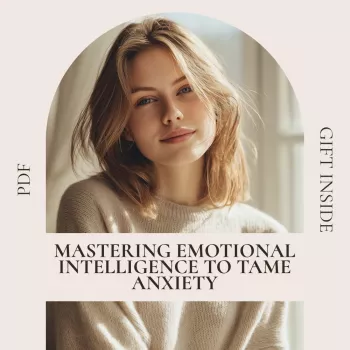
- Calm & Clever: Mastering Emotional Intelligence to Tame Anxiety | Practical eBook Guide to Emotional Intelligence and Anxiety for Lasting Calm ($10.99) — a structured toolkit for labeling emotions, regulating the body, and choosing the next best step.
- Armani Exchange Men’s Sneakers ($107.51) — comfortable walking can be a simple “regulate the body” practice when you need to discharge nervous energy.
- Triple-Sided Ultra-Fine Soft Bristle Toothbrush for Enhanced Oral Health ($1.52) — a steady evening cue can help anchor a wind-down routine when your mind wants to keep scanning for problems.
When to get extra support
A focused resource to build calm and emotional clarity
Calm & Clever: Mastering Emotional Intelligence to Tame Anxiety is designed as a practical, skill-building eBook rather than a purely inspirational read. Use it like a structured toolkit: pick one technique, practice it daily, and layer in the next tool once the first becomes familiar.
FAQ
Can emotional intelligence reduce anxiety, or does it only help manage it?
Emotional intelligence can do both: it helps manage anxiety in the moment and can reduce intensity and frequency over time by improving awareness, regulation, and behavior choices. The key is repeated practice so the calmer response becomes more automatic.
How long does it take to notice results from emotional regulation exercises?
Body-based tools (like longer exhales or grounding) can reduce intensity within minutes. More meaningful change—like fewer spirals and quicker recovery—typically builds over weeks with consistent repetition.
What if anxiety makes it hard to focus on reading and exercises?
Use tiny sessions and start with body calming first, then do one exercise at a time. Brief notes, checklists, or a single sentence often work better than long journaling when focus is limited.
Recommended for you


Was this article helpful?
Yes
No









Leave a comment