-
Shop
- Advanced Technologies
- AI Skills for Creators & Freelancers
- AI Client Management
- AI Ethics
- AI Mindset
- AI Tools & Prompts
- AI Writing & Content Creation
- Audio, Voice & Music
- Design & Visual Creation
- Email, Messaging & Communication
- Freelancing & Business
- Marketing, Ads & Conversion
- Productivity, Workflow & Automation
- SEO & Search Optimization
- Social Media Content & Growth
- Strategy, Planning & Analytics
- Video Creation & Editing
- AI Skills Mastery 2026 Collection
- Bathroom
- Best-Sellers
- Car Accessories
- Confidence
- Dating & Social Skills
- Digital Resources
- Easter Products
- Education & Learning
- Family & Parenting
- Fashion
- Fashion Accessories
- Furniture
- Gadgets
- Health & Beauty
- Health & Wellness
- Home & Garden
- Home Electronics
- Home Supplies
- Jewelry
- Kids & Babies
- Kitchen
- Lighting
- Patio, Lawn & Garden
- Personal Growth
- Pet Care
- Pet Supplies
- Pets
- Shoes
- Smart Home Living Guides
- Sport & Outdoors
- Stress Relief & Relaxation
- Super Deals
- TikTok Growth & Monetization Mastery
- Travel
- Travel & Adventure
- Wealth
- Wellness
Emotional Clarity for Calm, Honest Conversations
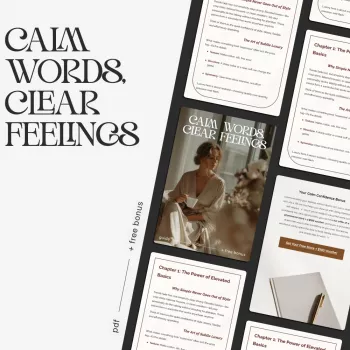
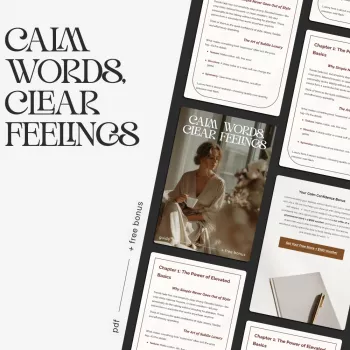
Calm Words, Clear Feelings: A Practical Guide to Emotional Clarity and Mindful Communication
Emotional clarity makes it easier to speak honestly without escalating tension. When feelings are named accurately and expressed with care, conversations become safer, boundaries become clearer, and misunderstandings shrink. Calm Words, Clear Feelings — Emotional Clarity Guide is a digital guide designed to help turn emotional overwhelm into grounded language—so needs can be shared without blame, shutdown, or regret.
Emotions aren’t “good” or “bad”—they’re signals. The American Psychological Association describes emotion as a complex pattern of experience, expression, and physiology that helps people respond to meaningful situations (APA Dictionary of Psychology). When that signal gets fuzzy, communication often turns reactive. When it gets clear, it becomes actionable.
Why emotional clarity changes the outcome of hard conversations
Most conflict isn’t caused by having feelings; it’s caused by not knowing how to translate them into words that can be heard. Emotional clarity shifts the entire “tone physics” of a conversation.
- Clarity reduces reactivity: naming the feeling lowers the urge to defend, accuse, or withdraw.
- Accurate emotions reveal the real need: beneath a conflict is often a need for respect, reassurance, time, support, or autonomy.
- Mindful wording protects connection: you can be direct without becoming sharp—especially in tense moments.
- Vague feelings force guessing: “I’m fine” leaves others to interpret; “I’m disappointed and need a plan” invites a response.
- Boundaries land better with clarity: explaining your limit without making the other person the problem reduces pushback.
What Calm Words, Clear Feelings helps you practice
This guide is built for real life: short, repeatable steps that work when you’re tired, triggered, or simply trying not to say something you’ll regret later.
- Identifying emotions with more precision than “mad,” “sad,” or “stressed.”
- Separating observations from interpretations to prevent mind-reading and assumptions.
- Turning emotional intensity into respectful statements that can be heard.
- Using brief self-regulation steps before speaking (pause, breathe, locate the feeling, choose the message).
- Preparing language for recurring situations: feedback, apologies, unmet expectations, and boundary-setting.
- Building confidence to express needs without overexplaining or self-abandoning.
For extra support beyond communication skills, mental health basics like sleep, stress management, and self-care routines can make emotional regulation easier day to day (NIMH: Caring for Your Mental Health).
A simple communication framework you can reuse
When emotions spike, it helps to have a structure that keeps you steady. This framework is designed to be quick enough to use in-the-moment, but strong enough for big conversations.
- Pause: notice body cues (tight chest, clenched jaw, racing thoughts) that signal rising intensity.
- Name: choose one or two specific emotions (hurt, anxious, disappointed, overwhelmed).
- Anchor: connect the emotion to a concrete moment without accusations—what happened, not what it “means.”
- Need: state the underlying need or value (clarity, reliability, respect, rest, support).
- Request: ask for one actionable next step (a check-in time, a change in tone, a plan, a boundary).
- Close: confirm the shared goal (understanding, teamwork, calm resolution), even if agreement takes time.
If stress is already running high, consider pairing the framework with a simple coping tool (like a short walk, slow breathing, or a reset routine). Practical strategies for coping with stress can make it easier to communicate without snapping (CDC: How to Cope with Stress).
Translate charged statements into calm, clear language
Small wording shifts reduce defensiveness while staying honest. The goal isn’t to “sound perfect”—it’s to increase understanding and reduce collateral damage.
- Use “I feel… when… because…” to describe impact instead of assigning motive.
- Replace global conclusions (“you never”) with specific examples and timeframes.
- Ask one question at a time; stack fewer issues per conversation.
- If emotions are high, choose containment: focus on one next step rather than the whole history.
Examples: from reactive to clear
| When it comes out like this | Try saying this instead | What it communicates |
|---|---|---|
| “You don’t care about me.” | “I’m feeling hurt and disconnected. Can we talk for 10 minutes tonight?” | Emotion + request without mind-reading |
| “Stop being so dramatic.” | “I’m getting overwhelmed. Can we slow down and take one point at a time?” | Self-regulation + structure |
| “You always do this.” | “This happened twice this week, and I’m frustrated. Can we agree on a plan?” | Specificity + problem-solving |
| “Fine, whatever.” | “I’m shutting down. I need a short break, then I can continue.” | Boundary + return plan |
| “I can’t trust you.” | “I feel anxious because the plan changed last minute. I need more notice going forward.” | Need + actionable expectation |
How to use the guide as a daily reset (5–10 minutes)
Consistency beats intensity. A short daily loop can keep communication skills available when you need them most.
Who this is for (and when it’s most helpful)
Product details: Calm Words, Clear Feelings (digital download)
Shop Calm Words, Clear Feelings — Emotional Clarity Guide
Small supportive add-ons for calmer days
- Universal Car Steering Wheel Phone Mount for Safe Navigation — reduces “where’s my phone?” stress during commutes and helps you stay hands-free.
- Triple-Sided Ultra-Fine Soft Bristle Toothbrush for Enhanced Oral Health — a simple self-care upgrade that can make morning/evening routines feel more grounding.
FAQ
Is this guide more about emotions or communication?
It connects both: emotional labeling and regulation are paired with practical language patterns (feelings, needs, requests) so conversations stay calm, specific, and easier to resolve.
How quickly can the exercises make a difference?
Small shifts can happen immediately—especially with a pause and a prepared sentence. Deeper patterns tend to improve with consistent practice over several weeks.
Can this help with conflict at work as well as in relationships?
Yes. The approach translates well to professional settings by emphasizing respectful wording, observable facts, and clear, actionable requests—while adapting tone to workplace norms.
Recommended for you


Was this article helpful?
Yes
No









Leave a comment