-
Shop
- Advanced Technologies
- AI Skills for Creators & Freelancers
- AI Client Management
- AI Ethics
- AI Mindset
- AI Tools & Prompts
- AI Writing & Content Creation
- Audio, Voice & Music
- Design & Visual Creation
- Email, Messaging & Communication
- Freelancing & Business
- Marketing, Ads & Conversion
- Productivity, Workflow & Automation
- SEO & Search Optimization
- Social Media Content & Growth
- Strategy, Planning & Analytics
- Video Creation & Editing
- AI Skills Mastery 2026 Collection
- Bathroom
- Best-Sellers
- Car Accessories
- Confidence
- Dating & Social Skills
- Digital Resources
- Easter Products
- Education & Learning
- Family & Parenting
- Fashion
- Fashion Accessories
- Furniture
- Gadgets
- Health & Beauty
- Health & Wellness
- Home & Garden
- Home Electronics
- Home Supplies
- Jewelry
- Kids & Babies
- Kitchen
- Lighting
- Patio, Lawn & Garden
- Personal Growth
- Pet Care
- Pet Supplies
- Pets
- Shoes
- Smart Home Living Guides
- Sport & Outdoors
- Stress Relief & Relaxation
- Super Deals
- TikTok Growth & Monetization Mastery
- Travel
- Travel & Adventure
- Wealth
- Wellness
Declutter Sentimental Items Gently: Heart–Clarity Method
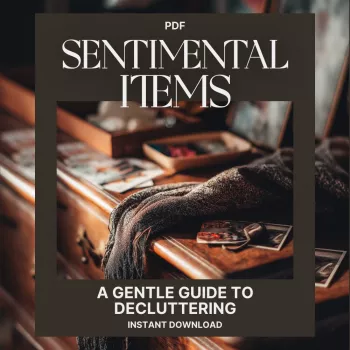
Sentimental Decluttering, Gently: Keep the Love, Lose the Weight
Sentimental clutter is rarely about “stuff” alone—it’s about memory, identity, and love. A gentle approach protects what matters while letting go of what makes daily life harder. The goal isn’t to erase the past; it’s to curate it with clarity, so the items you keep feel like support instead of pressure.
Why sentimental items are the hardest to sort
Sentimental objects often stand in for relationships, seasons of life, and personal milestones. A concert ticket can carry a whole friendship; a baby onesie can hold a decade of identity shifts. That’s why letting go can trigger guilt, grief, or fear of forgetting—emotions that can stall progress even when the space is bursting at the seams.
Decision fatigue shows up fast when every item feels “special.” Without clear criteria, you end up repeatedly re-living the same memories and re-arguing the same choice. A gentle plan helps by separating two different needs: memory-keeping (honoring the story) and space-keeping (what your home can realistically hold).
If grief is part of the picture, it can help to remember that strong feelings are a normal response to loss. The American Psychological Association’s overview of grief highlights how varied and personal grieving can be—so your pace can be personal, too.
Prepare for a calm, finite decluttering session
Start with boundaries that protect your nervous system. Choose a small container limit—one box, one bin, or one drawer—so the session can end with a visible win. Then set a short time boundary (20–45 minutes). Planning a soothing “after” activity (tea, a walk, a shower, a favorite show) helps your brain trust that this won’t turn into an emotional marathon.
Gather supplies before you begin: a keep box, a release box, a donate bag, a recycle bag, a phone/camera for quick photos, and labels. Finally, define the purpose of the space you’re reclaiming. Is it to make cleaning easier? Create calmer mornings? Open room for a hobby or creativity? A specific “why” makes decisions less abstract.
The Heart–Clarity method: a simple decision path
Begin with a low-stakes sentimental category to build confidence—greeting cards, travel souvenirs, school papers—before higher-stakes items like heirlooms or childhood keepsakes. Then use one primary question to guide nearly every decision:
Does this item actively support my life now, or is it mainly a memory trigger?
If it supports your life now, it may deserve a home where it’s used or displayed. If it’s mainly a memory trigger, you can often keep the memory without keeping the object.
When multiple items represent the same person or season, keep fewer, better representatives. Choose the single most meaningful piece instead of a full set, duplicates, or “just-in-case” versions. If you feel stuck, use a “maybe, later” parking box with a review date (for example: 60–90 days). This prevents spiraling while still honoring uncertainty.
Quick decision prompts for sentimental items
| Prompt | If the answer is yes | If the answer is no |
|---|---|---|
| Would I notice this is gone in 30 days? | Consider keeping or displaying it | Photograph it and release it |
| Does it carry a clear, positive story? | Keep one best example | Let it go or store only a photo of it |
| Is it replacing the person or the moment? | Create a memory ritual instead of storing more | Release with a note of gratitude |
| Would I want someone else to inherit this burden? | Curate a small legacy box | Donate/recycle/trash responsibly |
Ways to keep the memory without keeping the item
Many sentimental decisions become easier when you give yourself alternatives. Photograph items in good light and add a short caption (who/where/why it mattered). This turns a pile into an organized, searchable archive.
Gentle scripts for guilt, grief, and family pressure
If family members want items, offer a limited window to choose (two weeks is often plenty), then donate what remains. That boundary reduces drawn-out limbo. If certain items feel grief-heavy, choose a pace that supports healing: one small category at a time, with breaks. If clutter is tied to intense distress or impairment, reading about related patterns (like NIMH’s information on hoarding disorder) can provide helpful perspective and next-step ideas.
What to do with items you’re releasing
A supportive next step when emotions run high
For a structured, gentle approach, consider A Gentle Guide to Decluttering Sentimental Items (digital download). For small “fresh start” supports during reset days, Triple-Sided Ultra-Fine Soft Bristle Toothbrush for Enhanced Oral Health can be an easy upgrade for routines you’re simplifying, and Universal Car Steering Wheel Phone Mount for Safe Navigation can make donation drop-offs and errands less stressful when your hands and attention are already full.
FAQ
How do you declutter sentimental items without feeling guilty?
Treat guilt as a signal of care, then add clear limits (like one box per person or era) so you’re choosing intentionally instead of hoarding by default. Keep the best representatives, and preserve the memory with photos or a short written story plus a brief gratitude-and-release ritual.
What should be kept from childhood or a loved one who passed away?
Keep a small curated set that clearly represents the relationship—such as one letter, a favorite photo, or one heirloom-quality item. Avoid multiples, and prioritize pieces that are easy to store and bring genuine comfort when you see them.
Should sentimental items be decluttered last?
Often yes, because practicing on non-sentimental categories builds confidence and decision stamina. If momentum is needed, start with low-stakes sentimental categories in short sessions and use a “review later” box for the hardest items.
Recommended for you


Was this article helpful?
Yes
No









Leave a comment