-
Shop
- Advanced Technologies
- AI Skills for Creators & Freelancers
- AI Client Management
- AI Ethics
- AI Mindset
- AI Tools & Prompts
- AI Writing & Content Creation
- Audio, Voice & Music
- Design & Visual Creation
- Email, Messaging & Communication
- Freelancing & Business
- Marketing, Ads & Conversion
- Productivity, Workflow & Automation
- SEO & Search Optimization
- Social Media Content & Growth
- Strategy, Planning & Analytics
- Video Creation & Editing
- AI Skills Mastery 2026 Collection
- Bathroom
- Best-Sellers
- Car Accessories
- Confidence
- Dating & Social Skills
- Digital Resources
- Easter Products
- Education & Learning
- Family & Parenting
- Fashion
- Fashion Accessories
- Furniture
- Gadgets
- Health & Beauty
- Health & Wellness
- Home & Garden
- Home Electronics
- Home Supplies
- Jewelry
- Kids & Babies
- Kitchen
- Lighting
- Patio, Lawn & Garden
- Personal Growth
- Pet Care
- Pet Supplies
- Pets
- Shoes
- Smart Home Living Guides
- Sport & Outdoors
- Stress Relief & Relaxation
- Super Deals
- TikTok Growth & Monetization Mastery
- Travel
- Travel & Adventure
- Wealth
- Wellness
CFM Vacuum Pump Explained: Why 3.5 CFM Works

CFM Vacuum Pump Guide: What 3.5 CFM Means and When It Fits
A CFM vacuum pump is usually chosen by matching evacuation speed to system size and the level of vacuum required. CFM helps estimate how quickly a pump can move air out of a system, but it doesn’t automatically guarantee a deeper final vacuum. Below is a practical breakdown of what CFM represents, what really changes evacuation results in the field, and when a 3.5 CFM vacuum pump is a smart, cost-effective choice for HVAC and general service work.
What CFM Means for a Vacuum Pump
CFM stands for cubic feet per minute. For vacuum pumps, it typically refers to the pump’s approximate free-air displacement—how much air the pump can move under specified conditions. In simple terms: higher CFM usually means the pump can remove air faster, which can shorten evacuation time on larger systems.
That said, CFM is not the same as “how deep” a vacuum the pump can ultimately reach. Deep vacuum capability is commonly expressed in microns (absolute pressure). A pump can have a decent CFM rating and still struggle to pull and hold a low micron level if the oil is contaminated, the setup is restricted, or the system is leaking.
Real-world evacuation speed depends heavily on the entire setup, not just the pump label. Hose diameter, valve core restrictions, manifold limitations, fittings, leaks, and moisture load can all dominate the outcome. This is why a mid-range CFM pump paired with low-restriction practices can outperform a higher-CFM pump connected through small hoses and tight bottlenecks.
When a 3.5 CFM Pump Is a Good Fit
A 3.5 CFM vacuum pump sits in a practical “middle lane” for many service technicians and serious DIYers. It’s often a good match when faster pump-down is helpful, but the work doesn’t justify a bigger, more expensive high-CFM unit.
- Residential HVAC service: Helpful for common system sizes where time matters, but you’re not routinely evacuating large commercial volumes.
- Light commercial tasks: Suitable for smaller equipment where consistent evacuation practices matter more than maximum airflow.
- Routine evacuation workflows: After component replacement, line-set work, or moisture removal steps—when paired with proper leak checks and isolation tests.
- Portability and value priorities: A 3.5 CFM class pump is often easier to carry, easier on the budget, and still fast enough when the hose setup is optimized.
For best results, treat 3.5 CFM as part of a complete evacuation process: confirm tightness, reduce restrictions, and keep oil fresh. Guidance for evacuation and dehydration practices is also discussed in industry references like the ASHRAE Handbook—Refrigeration.
Key Specifications to Compare (Beyond CFM)
Two pumps can share the same CFM rating and perform very differently depending on build quality and support features. Compare these specs and design points before buying:
- Ultimate vacuum rating (microns): Indicates how deep the pump can pull under ideal conditions. Lower micron ratings generally signal deeper capability.
- Motor power and duty cycle: Affects stability on longer evacuations and in hot ambient conditions.
- Oil capacity and sight glass: Oil condition drives performance; a sight glass helps monitor oil level and clarity during use.
- Intake ports and adapters: If the port setup forces you into restrictive adapters, you can lose much of the CFM advantage.
- Gas ballast (if present): Can help manage water vapor on wet systems by reducing oil contamination in some scenarios.
- Weight, handle design, vibration: Impacts portability, stability, and comfort on the job.
Quick comparison checklist for a CFM vacuum pump
| Item to check | Why it matters | What to look for |
|---|---|---|
| Ultimate vacuum (microns) | Determines achievable dryness/pressure level | Lower micron rating for deeper vacuum (verify stated method) |
| CFM rating | Affects how fast evacuation progresses on larger volumes | Choose higher CFM for larger systems; avoid overspending for small volumes |
| Oil management | Oil condition affects performance and longevity | Sight glass, easy drain/fill, clear oil access |
| Port size/compatibility | Restrictions can negate CFM advantage | Ports that match hoses, core tools, and common adapters |
| Build and sealing | Leaks reduce performance and extend evacuation time | Quality fittings, robust housing, stable base |
Evacuation Time: What Changes Results the Most
If a system won’t pull down quickly—or won’t hold low microns—CFM is often not the main issue. These practical changes typically deliver the biggest improvement:
For unit and pressure concepts behind microns and related measurements, the NIST Guide to the SI is a reliable reference. For refrigerant handling context and technician requirements, see the EPA Section 608 information.
Care, Oil, and Storage Basics
Product Options In Stock
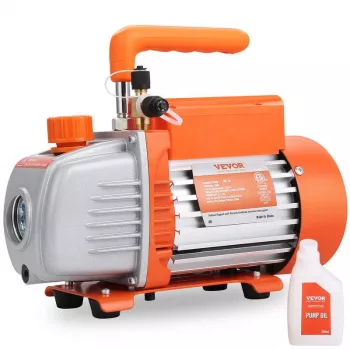
- 3.5 CFM Vacuum Pump — In stock at $67.01. A balanced option for many HVAC evacuation tasks where faster pump-down is beneficial without jumping to higher-cost categories.
- Universal Car Steering Wheel Phone Mount for Safe Navigation — In stock at $1.80. Useful for keeping route info visible between service calls when parked and staging equipment.
- Armani Exchange Men’s Sneakers — In stock at $107.51. A comfort-focused footwear option for long days moving between sites and equipment rooms.
FAQ
Is higher CFM always better for a vacuum pump?
Higher CFM usually reduces evacuation time on larger system volumes, but it doesn’t guarantee a deeper final vacuum. Hose restrictions, valve cores, leaks, and oil condition often matter more for reaching and holding low microns.
What does CFM tell about evacuation time?
CFM is related to pumping speed, so higher CFM can move air out faster under ideal conditions. Actual evacuation time depends on system volume, moisture load, hose diameter, core removal, and how tight the system is.
How often should vacuum pump oil be changed?
Change oil when it looks cloudy or dark, after pulling on wet or contaminated systems, and routinely if you want consistent deep vacuum performance. Fresh oil is one of the simplest ways to improve both evacuation speed and micron results.
Recommended for you


Was this article helpful?
Yes
No









Leave a comment