-
Shop
- Advanced Technologies
- AI Skills for Creators & Freelancers
- AI Client Management
- AI Ethics
- AI Mindset
- AI Tools & Prompts
- AI Writing & Content Creation
- Audio, Voice & Music
- Design & Visual Creation
- Email, Messaging & Communication
- Freelancing & Business
- Marketing, Ads & Conversion
- Productivity, Workflow & Automation
- SEO & Search Optimization
- Social Media Content & Growth
- Strategy, Planning & Analytics
- Video Creation & Editing
- AI Skills Mastery 2026 Collection
- Bathroom
- Best-Sellers
- Car Accessories
- Confidence
- Dating & Social Skills
- Digital Resources
- Easter Products
- Education & Learning
- Family & Parenting
- Fashion
- Fashion Accessories
- Furniture
- Gadgets
- Health & Beauty
- Health & Wellness
- Home & Garden
- Home Electronics
- Home Supplies
- Jewelry
- Kids & Babies
- Kitchen
- Lighting
- Patio, Lawn & Garden
- Personal Growth
- Pet Care
- Pet Supplies
- Pets
- Shoes
- Smart Home Living Guides
- Sport & Outdoors
- Stress Relief & Relaxation
- Super Deals
- TikTok Growth & Monetization Mastery
- Travel
- Travel & Adventure
- Wealth
- Wellness
Daily Inspiration That Sticks: Ignite Your Growth eBook
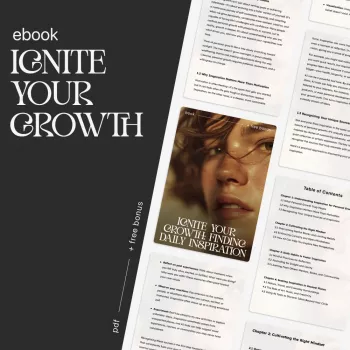
Ignite Your Growth: daily inspiration you can actually use
Personal growth usually isn’t a single dramatic breakthrough. It’s the quieter kind of progress that comes from small moments of clarity you can repeat—especially on normal, busy days. Our team created Ignite Your Growth: Finding Daily Inspiration (Digital eBook) to help you make inspiration feel less random and more reliable, so it becomes something you can work with, not something you wait for.
When inspiration turns into a next step—one boundary, one habit, one conversation, one page started—it becomes practical. This eBook is built around that idea: daily guidance that leads to action, even when motivation is low.
Daily inspiration that actually leads to growth
Inspiration becomes useful when it moves you into a clear “next.” Not a complete life overhaul—just a decision you can make today. The most consistent inspiration often shows up quietly as:
- A better question that cuts through the noise
- A clearer priority you can protect
- A small promise kept when you didn’t feel like it
We also lean on pattern-spotting. If the same idea keeps returning, or the same situation keeps draining you, that’s information. A daily approach lowers the pressure to “feel motivated” and replaces it with momentum—small wins that add up.
What this digital eBook helps you practice
In Ignite Your Growth, you’ll practice a simple set of skills that makes inspiration actionable:
- Find your starting point: define what “growth” means right now—skills, mindset, health, relationships, or purpose—so your effort stops scattering.
- Notice inspiration signals: recurring ideas, emotional spikes, friction points, envy cues, and curiosity trails.
- Translate sparks into micro-actions: a measurable next step you can do in 5–20 minutes.
- Build an inspiration loop: reflect, choose, act, and review, so progress becomes easier to repeat.
- Stay grounded on low-energy days: rely on structure (prompts, check-ins, simple routines) instead of waiting for the perfect mood.
If you like the “tiny steps” approach to behavior change, you’ll recognize the logic behind this structure; it’s consistent with established behavior design principles (see Stanford’s overview here: https://behaviordesign.stanford.edu/).
A simple 10-minute daily routine (use it with the eBook)
You don’t need an hour. You need a repeatable window. Here’s a 10-minute routine our team recommends:
- Minute 1–2: Check-in—name the dominant feeling and the one thing taking up mental space.
- Minute 3–5: Pick one focus—clarity (what matters today), courage (what you’re avoiding), or care (what supports energy).
- Minute 6–8: Choose a micro-action—send the message, outline the plan, take the walk, schedule the appointment.
- Minute 9–10: Close the loop—write one sentence: “Today I’m growing by…” and set one cue for the next step.
Use the same time window each day to reduce decision fatigue. Consistency beats intensity.
How to find inspiration when you feel stuck
Getting stuck is normal. The goal isn’t to force a big revelation; it’s to create movement that helps inspiration return. Try these resets:
Motivation research supports the value of practical strategies and environment cues over waiting on willpower (American Psychological Association: https://www.apa.org/topics/motivation).
A 7-day jumpstart plan (copy, paste, and go)
| Day | Prompt | Micro-action (10–20 minutes) | Win to record |
|---|---|---|---|
| Day 1 | What matters most this week? | Write 3 priorities and pick 1 for today | One clear priority chosen |
| Day 2 | What’s one thing to simplify? | Remove or reduce one small commitment | More space created |
| Day 3 | Where do I need courage? | Take one uncomfortable step (message, request, start) | Avoidance reduced |
| Day 4 | What gives energy? | Do one energizing habit (walk, tidy, stretch, create) | Energy improved by 1% |
| Day 5 | What lesson keeps repeating? | Write the pattern and one boundary/decision | Pattern named + response chosen |
| Day 6 | What skill would help most? | Practice the skill for 15 minutes | Practice completed |
| Day 7 | What worked this week? | Review notes; plan next 3 micro-actions | Next week feels simpler |
Use it like a tool, not a project
Simple reflection practices—like noting what worked and what you’re grateful for—can also support well-being over time (Greater Good Science Center: https://greatergood.berkeley.edu/topic/gratitude).
Helpful add-ons for keeping your routine consistent
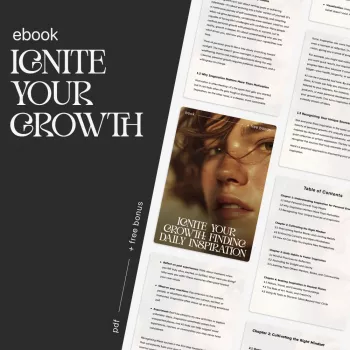
- Ignite Your Growth: Finding Daily Inspiration | Digital eBook — your daily prompts, micro-actions, and review structure in one place.
- Universal Car Steering Wheel Phone Mount for Safe Navigation — a simple way to keep your phone accessible for quick note capture when parked (always set things up before driving and never interact with your phone while the car is moving).
- Triple-Sided Ultra-Fine Soft Bristle Toothbrush for Enhanced Oral Health — useful if you like habit-stacking, pairing one small daily routine with another so consistency becomes automatic.
FAQ
How can inspiration become consistent instead of random?
Make it repeatable: use one daily prompt, take one small action, then do a quick review so you capture what worked. When you anchor it to the same time and place each day and keep the next step small, you can follow through even without strong motivation.
What if personal growth feels overwhelming right now?
Reduce the scope to 1% improvements by choosing one priority and one micro-action you can finish in 10–20 minutes. Consistency matters more than intensity, and a simple structure helps narrow your attention when everything feels like too much.
Is a digital eBook practical for daily use?
Yes—digital makes it easy to open on your phone, tablet, or computer whenever you need a reset. It also helps to pair it with a notes app or a basic journal so you can capture one insight and one next step quickly.
Recommended for you


Was this article helpful?
Yes
No









Leave a comment