-
Shop
- Advanced Technologies
- AI Skills for Creators & Freelancers
- AI Client Management
- AI Ethics
- AI Mindset
- AI Tools & Prompts
- AI Writing & Content Creation
- Audio, Voice & Music
- Design & Visual Creation
- Email, Messaging & Communication
- Freelancing & Business
- Marketing, Ads & Conversion
- Productivity, Workflow & Automation
- SEO & Search Optimization
- Social Media Content & Growth
- Strategy, Planning & Analytics
- Video Creation & Editing
- AI Skills Mastery 2026 Collection
- Bathroom
- Best-Sellers
- Car Accessories
- Confidence
- Dating & Social Skills
- Digital Resources
- Easter Products
- Education & Learning
- Family & Parenting
- Fashion
- Fashion Accessories
- Furniture
- Gadgets
- Health & Beauty
- Health & Wellness
- Home & Garden
- Home Electronics
- Home Supplies
- Jewelry
- Kids & Babies
- Kitchen
- Lighting
- Patio, Lawn & Garden
- Personal Growth
- Pet Care
- Pet Supplies
- Pets
- Shoes
- Smart Home Living Guides
- Sport & Outdoors
- Stress Relief & Relaxation
- Super Deals
- TikTok Growth & Monetization Mastery
- Travel
- Travel & Adventure
- Wealth
- Wellness
AI Edge for Freelancers: Stand Out With Better Systems

AI Edge: Practical Ways Creators Can Stand Out as Freelancers
Crowded marketplaces reward freelancers who move faster, communicate more clearly, and deliver consistently. The advantage isn’t louder marketing—it’s a cleaner workflow. Used well, AI can help creators tighten positioning, sharpen execution, and stay visible without sacrificing personal voice or quality. The goal is simple: reduce friction for clients while making outcomes more repeatable for you.
Why freelancing feels crowded (and where the real gaps are)
Most clients don’t have time to decode vague offers. They scan a few options, compare quickly, and pick the freelancer who makes the next step feel low-risk. That’s why clarity and proof often beat big claims.
Many freelancers appear interchangeable on the surface—same tools, similar portfolios, similar promises. Differentiation usually comes from process: how you run discovery, how you scope work, how you communicate constraints, and how you ship reliably.
The balancing act is speed versus quality. Speed without quality breaks trust. Quality without speed loses opportunities. The biggest gaps show up in discovery calls, scoping, proposals, and consistent marketing—areas where AI can help you systematize without sounding robotic.
What “AI edge” actually looks like in day-to-day work
An AI edge isn’t about replacing expertise; it’s about removing avoidable back-and-forth. Practically, it looks like turning vague requests into clear deliverables, timelines, and boundaries—fast.
- Generate structured options (packages, tiers, add-ons) so clients can choose instead of negotiate every detail.
- Improve consistency across onboarding, weekly updates, and reporting so no client feels “forgotten.”
- Accelerate research, drafting, and iteration while keeping final judgment human-led.
When a freelancer’s communication is consistent and decisive, clients experience confidence—and confidence is what closes deals and keeps retainers alive.
A simple workflow: discover → define → deliver → delight
Discover
After a call or email thread, use AI to summarize goals, constraints, and success metrics. The point is to capture what matters while it’s fresh: what “done” means, what must be avoided, and what the client will use to judge the work.
Define
Turn the summary into a tight scope: assumptions, exclusions, responsibilities, and a milestone plan. Clear boundaries reduce revision loops and prevent “just one more thing” from quietly expanding the project.
Deliver
Draft faster, then quality-check with repeatable checklists. AI can help produce first passes and spot inconsistencies, but your role is to ensure the final product is accurate, on-brand, and appropriate for the client’s audience.
Delight
Retention is built in the follow-through. Send recap emails, proactive progress updates, and next-step recommendations. This is where many freelancers lose easy repeat work—clients don’t always know what to ask for next, so make it obvious.
Where AI helps most (and where it can hurt)
AI is strongest when it supports structure and speed: outlines, ideation, competitive scans, language refinement, templates, and checklists. It’s especially useful when you want a consistent “house style” for proposals, onboarding, and reporting.
AI can hurt when it’s used carelessly—especially with confidential client data, unverifiable facts, and sensitive advice (legal, medical, financial). Generic-sounding copy is another risk: it can make strong work feel interchangeable.
Practical guardrails help keep quality high:
- Don’t paste sensitive information into tools that aren’t approved for that data.
- Verify facts and claims; keep a short list of sources when needed.
- Maintain a consistent personal tone by editing for your voice, not the tool’s default phrasing.
For risk-aware guidance, review the U.S. Federal Trade Commission’s AI guidance and the NIST AI Risk Management Framework.
Quick wins for visibility and a stronger client pipeline
Visibility gets easier when one project turns into many assets. Instead of posting sporadically, build a repeatable cadence: collect notes during delivery, then repurpose quickly after completion.
AI-assisted assets to create from a single completed project
| Asset | What it shows | Time-saving AI assist |
|---|---|---|
| Mini case study | Problem → approach → result | Summarize notes, draft sections, tighten clarity |
| Portfolio entry | Quality and scope | Generate bullet highlights and outcome-focused captions |
| Client testimonial request | Social proof | Draft a short, specific request and suggested prompts |
| Social post thread | Expertise and process | Outline key steps and transform into short-form writing |
| Proposal template upgrade | Professionalism and boundaries | Create reusable sections: scope, timeline, assumptions, FAQs |
Strong positioning can be structured simply: niche + outcome + proof + process. That keeps your message specific without boxing you in. Then build a “first 48 hours” follow-up system after inquiries: a confirmation message, a short clarification list, and a scheduling link or next step. Lead drop-off often comes from silence, not price.
Boost skills faster with focused practice loops
Recommended downloads and workday essentials (in stock)
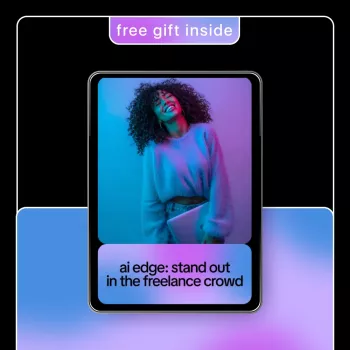
- AI Edge: Stand Out in the Freelance Crowd (digital download) — A practical guide built around templates and repeatable systems for proposals, onboarding, follow-ups, and consistent output.
- Universal Car Steering Wheel Phone Mount for Safe Navigation — Helpful for creators who travel to shoots, meetings, or coworking spaces and want quick, safer navigation.
- Armani Exchange Men’s Sneakers — A clean option for in-person client days when presentation matters.
What’s inside the digital guide
Digital download details and who it’s for
Get the guide
Shop AI Edge: Stand Out in the Freelance Crowd (digital download)
FAQ
Is this guide useful if AI tools feel overwhelming?
Yes. It’s built around simple, repeatable workflows and templates, so you can start with one use case—like proposals or onboarding—then expand as you get comfortable.
Will using AI make freelance work look generic?
Only if the output goes out unedited. Keep your work specific by adding your examples, concrete metrics, and a consistent voice, then review and verify before sending.
What kinds of freelancers benefit most from this approach?
Creators and service providers who need faster production, clearer client communication, and consistent visibility—writers, designers, marketers, editors, videographers, and consultants—tend to benefit most.
Recommended for you


Was this article helpful?
Yes
No









Leave a comment