-
Shop
- Advanced Technologies
- AI Skills for Creators & Freelancers
- AI Client Management
- AI Ethics
- AI Mindset
- AI Tools & Prompts
- AI Writing & Content Creation
- Audio, Voice & Music
- Design & Visual Creation
- Email, Messaging & Communication
- Freelancing & Business
- Marketing, Ads & Conversion
- Productivity, Workflow & Automation
- SEO & Search Optimization
- Social Media Content & Growth
- Strategy, Planning & Analytics
- Video Creation & Editing
- AI Skills Mastery 2026 Collection
- Bathroom
- Best-Sellers
- Car Accessories
- Confidence
- Dating & Social Skills
- Digital Resources
- Easter Products
- Education & Learning
- Family & Parenting
- Fashion
- Fashion Accessories
- Furniture
- Gadgets
- Health & Beauty
- Health & Wellness
- Home & Garden
- Home Electronics
- Home Supplies
- Jewelry
- Kids & Babies
- Kitchen
- Lighting
- Patio, Lawn & Garden
- Personal Growth
- Pet Care
- Pet Supplies
- Pets
- Shoes
- Smart Home Living Guides
- Sport & Outdoors
- Stress Relief & Relaxation
- Super Deals
- TikTok Growth & Monetization Mastery
- Travel
- Travel & Adventure
- Wealth
- Wellness
Build a Long-Game Mindset for Sustainable Success

The Long-Game Mindset: A Practical Path to Sustainable Growth and Resilience
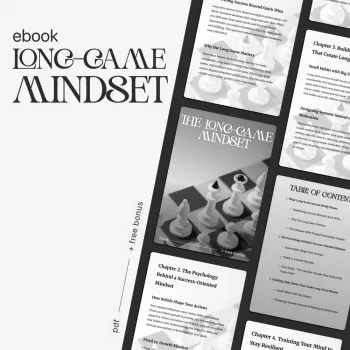
Short-term wins can feel urgent, but long-term success is built through repeatable habits, clear priorities, and the ability to stay steady under pressure. A long-game mindset supports consistent progress so goals don’t depend on motivation spikes, perfect timing, or external validation. If you want a structured, practical way to develop that framework, The Long-Game Mindset ebook is designed to help you build durable routines, make better decisions under stress, and keep moving when results are delayed.
What a long-game mindset looks like in daily life
A long-game mindset isn’t about “thinking positive.” It’s about choosing actions that compound, staying emotionally steady through imperfect weeks, and using process as your north star.
- Focus on direction over speed: choosing actions that compound even when results are delayed.
- Identity-based habits: acting like the kind of person who follows through (writer, builder, athlete, leader), not just chasing outcomes.
- Process trust: measuring success by inputs (practice sessions, deep work blocks, deliberate rest) rather than only outputs.
- Emotional steadiness: responding to setbacks with adjustment and learning instead of avoidance or self-criticism.
- Consistency with flexibility: staying committed to the goal while adapting methods as conditions change.
Short-game vs long-game decision patterns
| Situation | Short-game default | Long-game choice | Why it compounds |
|---|---|---|---|
| Plateau in progress | Quit or switch goals | Review inputs and continue for a set cycle | Stability enables skill and confidence to accumulate |
| Negative feedback | Defend or withdraw | Extract the lesson, refine, and re-ship | Iteration improves quality and resilience over time |
| Motivation drops | Wait to feel ready | Run the minimum viable routine | Small reps keep momentum and identity intact |
| Unexpected obstacle | All-or-nothing thinking | Adjust constraints and keep the next step small | Adaptability keeps the compounding engine running |
Core skills the ebook helps strengthen
Long-term progress is a skill set. When you treat it that way, setbacks become data, not verdicts.
- Delayed gratification: building comfort with slow feedback loops and long timelines.
- Self-regulation: managing stress responses so decisions remain values-driven rather than reactive.
- Strategic patience: knowing when to persist, when to pivot, and how to decide without panic.
- Sustainable ambition: pursuing meaningful goals without burning out or relying on constant intensity.
- Resilience loops: turning setbacks into usable data through reflection, reframing, and next-step planning.
For a clear definition of resilience as a psychological capacity, see the APA Dictionary of Psychology. For practical stress-management methods that support better decision-making, Stanford Health Care’s overview is a helpful reference: Stress Management.
A simple framework for long-term success: align, act, review, repeat
When progress feels messy, a lightweight framework keeps you from overcorrecting. This cycle turns effort into learning and learning into results.
- Align: define what “success” means in 12–36 months and identify non-negotiable values such as health, integrity, family time, or craft mastery.
- Act: translate goals into weekly systems—scheduled work blocks, practice reps, outreach targets, learning time, and recovery habits.
- Review: run a weekly check-in: What moved forward? What stalled? What was avoidable? What needs a smaller next step?
- Repeat: adjust the plan without self-blame; the goal is durability and steady iteration, not perfection.
- Guardrails: choose fewer priorities, protect sleep, and set boundaries around distractions and overcommitment.
Identity-based habit building is a proven way to make routines stick; James Clear’s work is a useful companion on behavior change concepts: Atomic Habits.
Sustainable growth without burnout
Burnout often comes from treating every week like a sprint. Long-game growth is more like capacity building: you expand, stabilize, and protect your ability to keep going.
Even small supports can help you stay consistent. If you’re building a daily movement habit, comfortable footwear can reduce friction and make routines easier to keep: Armani Exchange Men’s Sneakers. If your long-game includes health habits, upgrading a tiny daily routine can also reinforce identity: Triple-Sided Ultra-Fine Soft Bristle Toothbrush for Enhanced Oral Health.
Building resilience when progress is messy
If distractions regularly derail your focus blocks, a simple safety-first setup for navigation and quick checks can reduce friction while driving: Universal Car Steering Wheel Phone Mount for Safe Navigation.
Who this ebook is best for
Getting started: a 7-day long-game reset plan
Product details and what’s included
The Long-Game Mindset ebook is a digital, self-paced guide focused on long-term success, sustainable growth, and resilience through repeatable principles and routines. It’s designed to read once for clarity and revisit during plateaus, transitions, or high-stress periods.
At-a-glance
| Item | Details |
|---|---|
| Title | The Long-Game Mindset | Ebook on How to Build a Mindset for Long-Term Success, Sustainable Growth & Resilience |
| Price | 16.99 USD |
| Format | Ebook |
| Availability | In stock |
FAQ
What is a long-game mindset?
A long-game mindset prioritizes compounding habits, process, and learning over immediate outcomes. It changes decision-making under pressure by focusing on controllable inputs and long-term direction instead of short-term validation.
How can long-term success stay sustainable without burnout?
Sustainability comes from pacing, recovery, and designing routines that match real constraints. Keeping a minimum viable routine for hard weeks helps you stay consistent without relying on constant intensity.
How quickly can results show up when focusing on the long game?
Early results often show up as improved consistency, clearer priorities, and better follow-through within a few weeks. Measurable outcomes typically follow after repeated cycles, with many habits stabilizing around 2–6 weeks and bigger goals taking longer.
Recommended for you

Was this article helpful?
Yes
No









Leave a comment