-
Shop
- Advanced Technologies
- AI Skills for Creators & Freelancers
- AI Client Management
- AI Ethics
- AI Mindset
- AI Tools & Prompts
- AI Writing & Content Creation
- Audio, Voice & Music
- Design & Visual Creation
- Email, Messaging & Communication
- Freelancing & Business
- Marketing, Ads & Conversion
- Productivity, Workflow & Automation
- SEO & Search Optimization
- Social Media Content & Growth
- Strategy, Planning & Analytics
- Video Creation & Editing
- AI Skills Mastery 2026 Collection
- Bathroom
- Best-Sellers
- Car Accessories
- Confidence
- Dating & Social Skills
- Digital Resources
- Easter Products
- Education & Learning
- Family & Parenting
- Fashion
- Fashion Accessories
- Furniture
- Gadgets
- Health & Beauty
- Health & Wellness
- Home & Garden
- Home Electronics
- Home Supplies
- Jewelry
- Kids & Babies
- Kitchen
- Lighting
- Patio, Lawn & Garden
- Personal Growth
- Pet Care
- Pet Supplies
- Pets
- Shoes
- Smart Home Living Guides
- Sport & Outdoors
- Stress Relief & Relaxation
- Super Deals
- TikTok Growth & Monetization Mastery
- Travel
- Travel & Adventure
- Wealth
- Wellness
AI Self-Care Exercises: Mindfulness, Stress Relief & Journaling

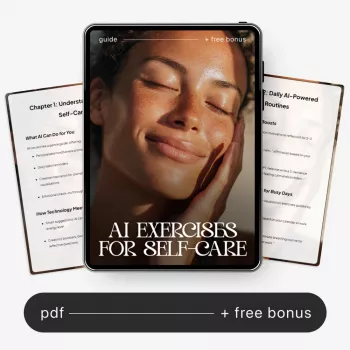
AI Exercises for Self-Care: A Digital Guide for Mindfulness, Stress Relief, and Journaling
Self-care works best when it’s specific, repeatable, and easy to start—especially on busy or emotionally heavy days. This digital guide pairs mindfulness and wellness basics with AI-assisted exercises to help shape realistic routines, reduce stress, and build a supportive journaling habit. Use it to create small, consistent practices that fit different moods, schedules, and energy levels, while keeping personal reflection structured and gentle.
What this digital guide helps with
The AI Exercises for Self-Care digital guide is built for short, practical sessions that don’t require a perfect environment or a long attention span. It supports:
- Mindfulness exercises that can be completed in short sessions (2–15 minutes) without special equipment
- Stress relief practices that focus on nervous-system downshifting (breath, grounding, sensory reset)
- Journaling frameworks that reduce “blank page” pressure and guide reflection step-by-step
- Planning pages that turn intentions into simple routines (daily, weekly, and “rough day” options)
- AI-assisted variations that keep practices fresh while staying anchored to familiar structures
For a helpful overview of what stress can do to the body (and why tiny regulation practices matter), see the American Psychological Association’s resource on stress effects.
How AI-assisted self-care exercises fit into real life
Some days call for deep reflection; other days call for the smallest possible win. AI-assisted variations are most useful when they simplify choices rather than adding more. A practical approach looks like this:
- Personalization without complexity: choose a goal (calm, focus, reset, unwind) and generate an exercise variation that matches the time available.
- Consistency over intensity: small practices done often can be more sustainable than occasional long sessions.
- A supportive mirror for journaling: structured questions help name emotions, needs, and next steps without forcing a “perfect” narrative.
- Boundaries and safety: AI can support reflection and habit-building, but it does not replace professional mental health care when symptoms are severe or persistent.
If you’re curious about evidence and safety considerations around mindfulness, the National Center for Complementary and Integrative Health (NCCIH) offers a clear, balanced overview.
Core practice sets inside the guide
Instead of forcing one “right” method, the guide uses a few core sets you can rotate through. Each set is simple enough to repeat, but flexible enough to adapt.
Mindful breathing
- Paced breathing to slow down and steady attention
- Box breathing for structure (especially during transitions)
- Gentle breath counting when you need something easy and repetitive
Grounding and sensory regulation
- 5-4-3-2-1 scan to reconnect with the present moment
- Temperature change (cool water, warm mug) for a quick sensory reset
- Sound mapping to widen attention and reduce “tunnel vision” stress
- Tactile anchoring (fabric, smooth stone, textured object) for steadiness
Body check-ins
- Tension scans to notice where you’re bracing
- Posture resets that reduce the “compressed” feeling of stress
- Micro-stretches paired with a short reflection to release and reorient
Cognitive declutter + self-compassion
- “Thought download” pages that separate facts, fears, and actionable next steps
- Self-compassion reframes that shift harsh self-talk into neutral or kind language (without pretending everything is fine)
A flexible routine builder (choose-your-own path)
When self-care feels like another chore, a lightweight structure helps. The routine builder uses a simple flow you can repeat daily or only on rough days:
- Start with a check-in: energy level, stress level, and available time.
- Select one anchor: breath, body, senses, or journaling.
- Add one support: music, tea, a short walk, or a stretch.
- End with tiny closure: one sentence of intention, one next step, or one gratitude note.
For hard days, the guide treats “minimum viable” as legitimate: 60 seconds counts as a win when consistency is the goal.
Quick self-care routine options (mix and match)
| Time available | Mindfulness reset | Journaling focus | Best for |
|---|---|---|---|
| 2–3 minutes | 3 slow exhales + name 3 sounds in the room | One-line check-in: “Right now I feel… and I need…” | Overwhelm, busy schedules |
| 5 minutes | Box breathing (4-4-4-4) + shoulder drop | Brain-dump bullets (no sentences required) | Racing thoughts, transition moments |
| 10 minutes | 5-4-3-2-1 grounding + brief body scan | Guided reflection: trigger → feeling → need → next step | Stress spikes, irritability |
| 15 minutes | Paced breathing + mindful walk (indoors or outdoors) | Values check: “What matters today?” + plan one aligned action | Low mood, decision fatigue |
Journaling prompts that support mental wellness (without overthinking)
Journaling tends to work best when it’s guided enough to reduce pressure, but open enough to tell the truth. These prompt styles help you reflect without getting stuck:
Ways to use the planner pages week to week
A simple way to support habit stacking is to reduce friction around daily basics. For example, pairing a two-minute breath practice right after brushing can be easier when your tools are comfortable and gentle, like the Triple-Sided Ultra-Fine Soft Bristle Toothbrush.
Getting started in 10 minutes
For additional guidance on everyday mental health care and when to seek support, the National Institute of Mental Health (NIMH) is a reliable starting point.
FAQ
Is this guide suitable for beginners who are new to mindfulness or journaling?
Yes. It’s structured around short time options (2–15 minutes), simple instructions, and low-pressure journaling formats that reduce “blank page” stress while still guiding reflection.
How do AI-assisted exercises support self-care without feeling overwhelming?
They work best when you start with a small goal (calm, focus, reset, unwind) and a time limit, then use familiar frameworks with gentle variations. That way, the steps stay simple while the experience stays engaging.
Can this replace therapy or professional mental health support?
No. It’s a self-care and planning tool, not a medical treatment, and it isn’t a substitute for therapy. If symptoms are severe, persistent, or include safety concerns, seek support from a qualified professional right away.
Recommended for you


Was this article helpful?
Yes
No









Leave a comment