-
Shop
- Advanced Technologies
- AI Skills for Creators & Freelancers
- AI Client Management
- AI Ethics
- AI Mindset
- AI Tools & Prompts
- AI Writing & Content Creation
- Audio, Voice & Music
- Design & Visual Creation
- Email, Messaging & Communication
- Freelancing & Business
- Marketing, Ads & Conversion
- Productivity, Workflow & Automation
- SEO & Search Optimization
- Social Media Content & Growth
- Strategy, Planning & Analytics
- Video Creation & Editing
- AI Skills Mastery 2026 Collection
- Bathroom
- Best-Sellers
- Car Accessories
- Confidence
- Dating & Social Skills
- Digital Resources
- Easter Products
- Education & Learning
- Family & Parenting
- Fashion
- Fashion Accessories
- Furniture
- Gadgets
- Health & Beauty
- Health & Wellness
- Home & Garden
- Home Electronics
- Home Supplies
- Jewelry
- Kids & Babies
- Kitchen
- Lighting
- Patio, Lawn & Garden
- Personal Growth
- Pet Care
- Pet Supplies
- Pets
- Shoes
- Smart Home Living Guides
- Sport & Outdoors
- Stress Relief & Relaxation
- Super Deals
- TikTok Growth & Monetization Mastery
- Travel
- Travel & Adventure
- Wealth
- Wellness
Critical Thinking eBook: Decision Tools & Brain Teasers

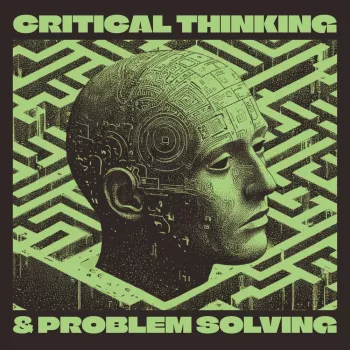
Critical Thinking & Problem Solving eBook (Digital Download): Smarter Decisions, Better Reasoning, Practical Brain Teasers
Clear thinking is a learnable skill. This digital eBook is built to strengthen everyday reasoning, reduce costly mental mistakes, and turn problem solving into a repeatable process—using short frameworks, real-life scenarios, and brain teasers that train accuracy under pressure. If decisions sometimes feel rushed, murky, or hard to explain afterward, a simple structure can create calm, consistent progress.
What changes when critical thinking becomes a habit
- Decisions feel less reactive: define the problem, set criteria, evaluate options, then act.
- Less “confidence without evidence”: get better at spotting assumptions and missing information.
- Better conversations: ask sharper questions, separate claims from proof, and reduce misunderstandings.
- Improved follow-through: choices become easier to explain and simpler to revisit as new facts appear.
- Practical benefit: fewer avoidable errors in money choices, work priorities, relationships, and personal goals.
To explore the psychology behind everyday decisions and common thinking shortcuts, see the APA’s overview of behavioral economics. For a more formal definition of critical thinking, the Stanford Encyclopedia of Philosophy provides a helpful reference point.
What’s included in the digital download
- Step-by-step decision tools that can be reused for different situations.
- Problem-solving techniques for breaking complex issues into manageable parts.
- Brain teasers and logic-style exercises that build mental flexibility and pattern recognition.
- Everyday life skills applications: planning, prioritizing, conflict handling, and risk evaluation.
- A self-paced format designed for short practice sessions (ideal for busy schedules).
Get the full download here: Critical Thinking & Problem Solving eBook – Digital Download.
A simple decision workflow to apply immediately
When a choice feels overwhelming, it usually means too many assumptions are floating around untested. This workflow keeps the thinking grounded while still moving forward.
- Clarify the outcome: write what “good” looks like in one sentence.
- List constraints: time, budget, obligations, non-negotiables, and trade-offs.
- Generate options: include at least one “do nothing” option and one unconventional option.
- Evaluate with criteria: impact, likelihood, reversibility, and cost of delay.
- Stress-test the top choice: identify what would change the decision and what data is missing.
- Commit and review: set a checkpoint date so decisions evolve with evidence.
Decision quick-check: common traps and a better question
| Mental trap | What it sounds like | Better question to ask |
|---|---|---|
| Confirmation bias | “This proves I’m right.” | “What evidence would prove me wrong?” |
| Sunk cost | “Too much invested to stop.” | “If starting today, would this still be the best choice?” |
| Availability bias | “I heard about it recently, so it’s likely.” | “What do base rates or broader data say?” |
| Overconfidence | “I’m sure this will work.” | “What are the top 3 ways this could fail?” |
| Binary thinking | “It’s either A or B.” | “What’s a third option or a hybrid?” |
For a plain-language breakdown of cognitive biases and ways to reduce them, this overview on cognitive biases and debiasing is a useful companion read.
How brain teasers strengthen real-world problem solving
- Train working memory: hold multiple constraints in mind without losing track.
- Build comfort with uncertainty: test hypotheses instead of forcing quick answers.
- Improve pattern detection: notice structure, not just surface details.
- Practice “explain your reasoning”: clearer steps tend to produce more accurate results.
- Transfer skill: the same reasoning patterns help with planning, negotiations, debugging, and learning new concepts.
The goal isn’t to become “good at puzzles.” It’s to become reliably good at the thinking moves puzzles demand: defining constraints, checking assumptions, and noticing when a tempting answer is just a familiar answer.
A 14-day practice plan that fits into 10–15 minutes a day
- Days 1–3: baseline—solve a few puzzles, then write how the solution was reached (process over speed).
- Days 4–6: assumptions—take one daily decision and list hidden assumptions; challenge at least one.
- Days 7–9: alternatives—practice generating 5 options before choosing (even for small choices).
- Days 10–12: evidence—separate facts, interpretations, and guesses in a real situation.
- Days 13–14: review—repeat early exercises and compare reasoning clarity and speed.
- Tip: keep a simple decision log for one week to spot recurring biases and patterns.
Who this eBook works best for
- Students who want stronger reasoning for exams, essays, and research.
- Professionals who make frequent trade-offs: time, cost, quality, and risk.
- People who feel stuck in indecision and want a repeatable way to move forward.
- Anyone who enjoys puzzles and wants that enjoyment to translate into practical life skills.
- Readers who prefer self-paced learning with actionable exercises rather than theory alone.
Getting started after purchase (digital download basics)
A practical way to judge progress
Helpful add-ons for daily practice
- Universal Car Steering Wheel Phone Mount for Safe Navigation (useful for hands-free navigation so your attention stays on the road).
- Triple-Sided Ultra-Fine Soft Bristle Toothbrush for Enhanced Oral Health (an easy reminder habit: pair a 10-minute thinking session with a morning or evening routine).
- Armani Exchange Men’s Sneakers (a simple cue for a “walk and think” session—many decisions get clearer after movement).
FAQ
Is this eBook suitable for beginners with no formal logic background?
Yes. The material is approachable and focuses on step-by-step reasoning, guided practice, and brain teasers that teach the process—not just the answer.
How long does it take to notice improvement in decision making?
Small gains often show up within a few days of consistent practice (especially in clarity and calmer choices). Stronger, more consistent improvements typically appear over 2–4 weeks with a short daily routine.
Can the exercises be used for work and school situations, not just puzzles?
Yes. The same frameworks apply to planning, prioritizing, evaluating options, checking evidence, and communicating reasoning clearly in real-world scenarios.
Recommended for you

Was this article helpful?
Yes
No









Leave a comment