-
Shop
- Advanced Technologies
- AI Skills for Creators & Freelancers
- AI Client Management
- AI Ethics
- AI Mindset
- AI Tools & Prompts
- AI Writing & Content Creation
- Audio, Voice & Music
- Design & Visual Creation
- Email, Messaging & Communication
- Freelancing & Business
- Marketing, Ads & Conversion
- Productivity, Workflow & Automation
- SEO & Search Optimization
- Social Media Content & Growth
- Strategy, Planning & Analytics
- Video Creation & Editing
- AI Skills Mastery 2026 Collection
- Bathroom
- Best-Sellers
- Car Accessories
- Confidence
- Dating & Social Skills
- Digital Resources
- Easter Products
- Education & Learning
- Family & Parenting
- Fashion
- Fashion Accessories
- Furniture
- Gadgets
- Health & Beauty
- Health & Wellness
- Home & Garden
- Home Electronics
- Home Supplies
- Jewelry
- Kids & Babies
- Kitchen
- Lighting
- Patio, Lawn & Garden
- Personal Growth
- Pet Care
- Pet Supplies
- Pets
- Shoes
- Smart Home Living Guides
- Sport & Outdoors
- Stress Relief & Relaxation
- Super Deals
- TikTok Growth & Monetization Mastery
- Travel
- Travel & Adventure
- Wealth
- Wellness
Public Speaking Confidence: Calm Nerves, Speak With Impact

Public Speaking Confidence: A Practical Path to Calm Nerves and Speak With Impact
Speaking in front of others can trigger racing thoughts, shaky hands, and a tight throat—even when the message matters. Confidence isn’t a personality trait reserved for a few; it’s a set of skills that can be practiced, reinforced, and repeated under pressure. The goal isn’t to eliminate nerves. It’s to stay steady enough to deliver a clear message, connect with people, and recover quickly if something goes off-script.
Why fear of public speaking happens (and why it feels so physical)
Stage fright is often a stress response: the body interprets attention and evaluation as risk, then floods the system with adrenaline. That’s why symptoms like dry mouth, trembling, fast heartbeat, and mental blanking can arrive even when preparation is solid. Those sensations are common outcomes of heightened arousal—not evidence of failure.
Confidence grows when the body learns, through repetition, that speaking situations are safe and controllable. That learning is physical as much as mental: each “I spoke and I was okay” experience trains the nervous system to settle faster next time. The American Psychological Association explains how stress affects the body and why physical symptoms can appear quickly under pressure (APA: Stress effects on the body).
Progress is rarely linear. A strong talk can be followed by a shaky one. The target isn’t perfection; it’s resilience: re-centering, continuing, and improving the next rep.
Shift the goal: from “no nerves” to “steady under pressure”
Chasing “no nerves” often backfires, because the moment you feel anxiety you assume you’re failing. Instead, set a performance target you can control: clear structure, audible voice, controlled pace, and purposeful pauses.
Try a simple reframe: nerves are energy. The skill is directing that energy into the next sentence, not fighting sensations. Measure success with behaviors (opened strong, paused after a key line, made one point land) rather than feelings (felt anxious).
Before any talk, define a pre-talk “minimum viable win”: one solid opening and one crisp takeaway. If you deliver those two moments well, you’ve already created value—even if your hands still feel a little shaky.
Calm your body fast: a pre-speech routine that works anywhere
A reliable routine reduces guesswork and keeps your mind from spiraling. Use this 2–5 minute sequence in the hallway, the restroom, your car, or the back of the room.
1) Long-exhale breathing (60–120 seconds)
Inhale gently, then exhale a little longer than you inhaled. A longer exhale helps downshift arousal and steadies breath support for speaking. Keep it subtle—no need to “deep breathe” dramatically.
2) Release tension (15–30 seconds)
Unclench the jaw, drop the shoulders, soften the hands. Tension often travels into vocal strain and a rushed pace, so loosening the body protects your voice.
3) Grounding (15–30 seconds)
Feel both feet. Notice three objects in the room. Then return attention to your first line. The point is to stop scanning for danger and reconnect to something concrete.
4) Quick voice warm-up (30–60 seconds)
Hum lightly, speak a few lines at a relaxed pace, and practice the first sentence with a pause. Starting slow is one of the fastest ways to sound confident.
If the mind goes blank
Pause. If there’s water, take a sip. Restate your last point in a simple sentence, then move to the next prepared section. A calm pause reads as composure, not failure.
| Moment | Tool | How it helps | Time needed |
|---|---|---|---|
| 5–10 minutes before | Long-exhale breathing | Lowers arousal; steadies breath support for speaking | 1–2 minutes |
| Right before starting | Posture reset + slow first line | Prevents rushing; sets confident tempo | 30–60 seconds |
| During a shaky moment | Pause + deliberate pace | Breaks the spiral; increases clarity and authority | 5–15 seconds |
| After a stumble | Bridge sentence | Keeps the audience oriented; restores flow | 10–20 seconds |
Build confidence through structure: make it easy for the audience to follow
When nerves rise, memory narrows. Structure becomes your safety rail. Use a simple framework: opener → 2–4 main points → close with one clear takeaway.
Speak with impact: voice, pace, and presence without trying to “act confident”
For work presentations, practical communication guidance and delivery principles are often discussed in leadership contexts (Harvard Business Review: Presentations).
Practice that actually changes anxiety: a 7–14 day confidence plan
Tools that support your practice (simple, practical picks)
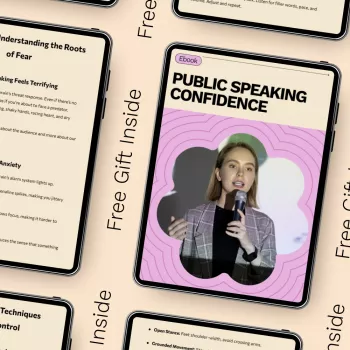
- Public Speaking Confidence | Ebook Guide on How to Overcome Fear of Public Speaking | Build Confidence, Calm Nerves & Speak With Impact — A practical, repeatable approach for body control, structure, and delivery drills.
- Universal Car Steering Wheel Phone Mount for Safe Navigation — Useful for hands-free recording when you’re practicing (parked) and reviewing your pace, pauses, and clarity.
- Armani Exchange Men’s Sneakers — Comfort and stable footing can help reduce fidgeting and support a grounded stance during longer speaking days.
Common mistakes that keep fear in control (and what to do instead)
If anxiety feels persistent across many situations, it may help to learn how anxiety works more broadly (NIMH: Anxiety disorders overview).
FAQ
How long does it take to feel more confident speaking in public?
With daily short practice, noticeable improvement often shows up in 1–2 weeks, especially when you repeat the opening and transitions and do small exposure reps. High-stakes comfort usually takes longer, but steadiness can improve well before anxiety disappears.
What if my voice shakes or my mind goes blank during a talk?
Pause, take a slower exhale, and restart with a simple sentence that restates your last point. Use a bridge sentence to move to the next prepared section, and rely on anchor phrases rather than memorized paragraphs.
Can nervousness ever be helpful for speaking with impact?
Yes—moderate arousal can add energy and focus when you control pace, use pauses, and follow a clear structure. The goal is control and recovery, not zero nerves.
Recommended for you


Was this article helpful?
Yes
No









Leave a comment