-
Shop
- Advanced Technologies
- AI Skills for Creators & Freelancers
- AI Client Management
- AI Ethics
- AI Mindset
- AI Tools & Prompts
- AI Writing & Content Creation
- Audio, Voice & Music
- Design & Visual Creation
- Email, Messaging & Communication
- Freelancing & Business
- Marketing, Ads & Conversion
- Productivity, Workflow & Automation
- SEO & Search Optimization
- Social Media Content & Growth
- Strategy, Planning & Analytics
- Video Creation & Editing
- AI Skills Mastery 2026 Collection
- Bathroom
- Best-Sellers
- Car Accessories
- Confidence
- Dating & Social Skills
- Digital Resources
- Easter Products
- Education & Learning
- Family & Parenting
- Fashion
- Fashion Accessories
- Furniture
- Gadgets
- Health & Beauty
- Health & Wellness
- Home & Garden
- Home Electronics
- Home Supplies
- Jewelry
- Kids & Babies
- Kitchen
- Lighting
- Patio, Lawn & Garden
- Personal Growth
- Pet Care
- Pet Supplies
- Pets
- Shoes
- Smart Home Living Guides
- Sport & Outdoors
- Stress Relief & Relaxation
- Super Deals
- TikTok Growth & Monetization Mastery
- Travel
- Travel & Adventure
- Wealth
- Wellness
Emergency Fund Targets by Age: Now, Soon, Later
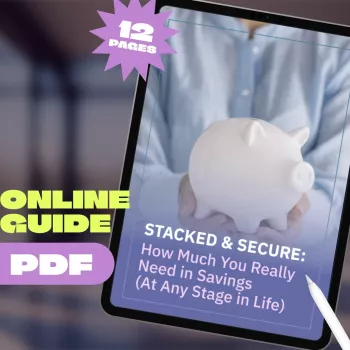
Stacked & Secure: How Much You Really Need in Savings at Every Stage of Life
Savings targets feel simple until real life adds rent, debt, kids, job changes, and uneven income. A “right” number depends on stability, fixed costs, responsibilities, and how quickly cash would be needed. The clearest way to stop guessing is to split savings into three buckets—now, soon, and later—then set benchmarks that match your current risk and life stage.
Start with the three buckets: now, soon, later
Most stress around saving comes from mixing up what money is for. When every dollar sits in one pile, “surprises” (many of which are predictable) can wipe out progress overnight.
- “Now” money: an emergency fund for true surprises—job loss, urgent medical bills, an essential repair.
- “Soon” money: sinking funds for predictable costs—insurance premiums, car maintenance, annual fees, travel, holidays, deductibles.
- “Later” money: long-term investing for retirement and long-range goals; it’s not meant to pay next year’s bills.
- A strong plan fills “now” first, then “soon,” then accelerates “later,” while keeping minimum debt payments covered.
- If income is irregular, plan for larger “now” and “soon” cushions to reduce month-to-month pressure.
Think of it as timing: emergencies need same-day access; sinking funds need access within weeks or months; investing needs years to work without being interrupted.
Emergency fund targets that match real risk
A common benchmark is 3–6 months of essential expenses—housing, utilities, food, insurance, and minimum debt payments. Essential expenses (not income) keep the target realistic and tailored to your lifestyle.
Some situations call for more. A single income household, commission work, seasonal income, health uncertainty, or a volatile industry often fits better with 6–12 months. On the flip side, 2–3 months can work if you have dual stable incomes, a strong job market, low fixed costs, and a dependable support network.
Keep emergency funds liquid and low-volatility—high-yield savings accounts or money market accounts—so you’re not forced to sell investments at a bad time. Guidance from the Consumer Financial Protection Bureau (CFPB) reinforces the importance of accessible emergency savings that can be used quickly when something breaks or income pauses.
Emergency fund quick guide
| Situation | Suggested range | Why it fits |
|---|---|---|
| Stable job, low fixed costs, dual incomes | 2–4 months | Lower chance of extended income loss; expenses easier to reduce |
| Average stability, moderate fixed costs | 3–6 months | Balanced protection for common disruptions |
| Irregular income or single income household | 6–12 months | More time needed to replace income without debt |
| Major responsibilities (kids/caregiver) or health risk | 6–12 months | Higher cost of surprises and fewer options to cut spending |
Savings milestones by life stage (with flexible benchmarks)
Early career (late teens–20s)
Start with a starter cushion (often one month of essentials). If high-interest debt is in the picture, keep building gradually while aggressively paying that debt down. Even small automated investing can begin here—consistency matters more than size.
Late 20s–30s
Stabilize at 3–6 months of essentials, then add sinking funds for the life you actually live: car repairs, annual bills, moving costs, home projects, childcare, or a down payment timeline. This stage often improves fastest when savings are automated and separated by purpose.
40s
Protect momentum. If responsibilities are high, maintaining 6+ months can be the difference between a setback and staying on track. Increase retirement contributions and plan for bigger “soon” expenses like home repairs, education support, and caregiving. Retirement-by-age concepts can be useful as a reference point (see Fidelity’s overview: how much to save for retirement).
50s–60s
Reduce the risk of forced withdrawals by keeping a stronger cash buffer and mapping your retirement transition. This is a good time to review insurance, target dates for debt payoff, and any planned large purchases. If you’re maximizing retirement accounts, confirm annual contribution limits through the IRS retirement plan guidance.
Retirement
The overlooked layer: sinking funds for predictable “surprises”
From savings to freedom: the bridge between cash and investing
Common scenarios and what to do next
A step-by-step roadmap that turns benchmarks into a plan
- Pick one primary goal (example: “3 months of essentials”) and one secondary goal (example: “car repair sinking fund”) to avoid scattershot saving.
- Review quarterly. If fixed costs rise, update targets; if stability improves, shift more money toward long-term investing.
- For a guided, stage-by-stage breakdown with clear targets and examples, use Stacked & Secure: How Much You Really Need in Savings (At Any Stage in Life) – Digital Guide on How Much to Save for Financial Freedom.
Small, practical upgrades can also reduce “surprise” spending: keeping navigation hands-free with a Universal Car Steering Wheel Phone Mount for Safe Navigation, replacing essentials on a budget with a Triple-Sided Ultra-Fine Soft Bristle Toothbrush for Enhanced Oral Health, and watching lifestyle creep purchases (like “treat” upgrades) before they crowd out savings goals—especially when shopping items such as Armani Exchange Men’s Sneakers.
FAQ
How much should be in an emergency fund before investing?
Aim for a starter emergency fund first—often about one month of essential expenses—so a small setback doesn’t send you to a credit card. If possible, begin modest investing while building toward a fuller 3–6 months (or more if your income is irregular or responsibilities are high).
Should savings be based on income or expenses?
Use essential expenses to size your emergency fund, since bills—not income—determine how long you can last. Use income-based percentages to automate saving and investing contributions so progress scales up as earnings rise.
Is it better to pay off debt or build savings first?
Build a small starter cushion first to avoid taking on new debt when something predictable hits. After that, prioritize high-interest debt while steadily expanding your emergency fund, adjusting toward a larger cash buffer if income is unstable or a major expense is imminent.
Recommended for you


Was this article helpful?
Yes
No









Leave a comment