-
Shop
- Advanced Technologies
- AI Skills for Creators & Freelancers
- AI Client Management
- AI Ethics
- AI Mindset
- AI Tools & Prompts
- AI Writing & Content Creation
- Audio, Voice & Music
- Design & Visual Creation
- Email, Messaging & Communication
- Freelancing & Business
- Marketing, Ads & Conversion
- Productivity, Workflow & Automation
- SEO & Search Optimization
- Social Media Content & Growth
- Strategy, Planning & Analytics
- Video Creation & Editing
- AI Skills Mastery 2026 Collection
- Bathroom
- Best-Sellers
- Car Accessories
- Confidence
- Dating & Social Skills
- Digital Resources
- Easter Products
- Education & Learning
- Family & Parenting
- Fashion
- Fashion Accessories
- Furniture
- Gadgets
- Health & Beauty
- Health & Wellness
- Home & Garden
- Home Electronics
- Home Supplies
- Jewelry
- Kids & Babies
- Kitchen
- Lighting
- Patio, Lawn & Garden
- Personal Growth
- Pet Care
- Pet Supplies
- Pets
- Shoes
- Smart Home Living Guides
- Sport & Outdoors
- Stress Relief & Relaxation
- Super Deals
- TikTok Growth & Monetization Mastery
- Travel
- Travel & Adventure
- Wealth
- Wellness
Daily Discipline Checklist: Printable Self-Discipline Plan
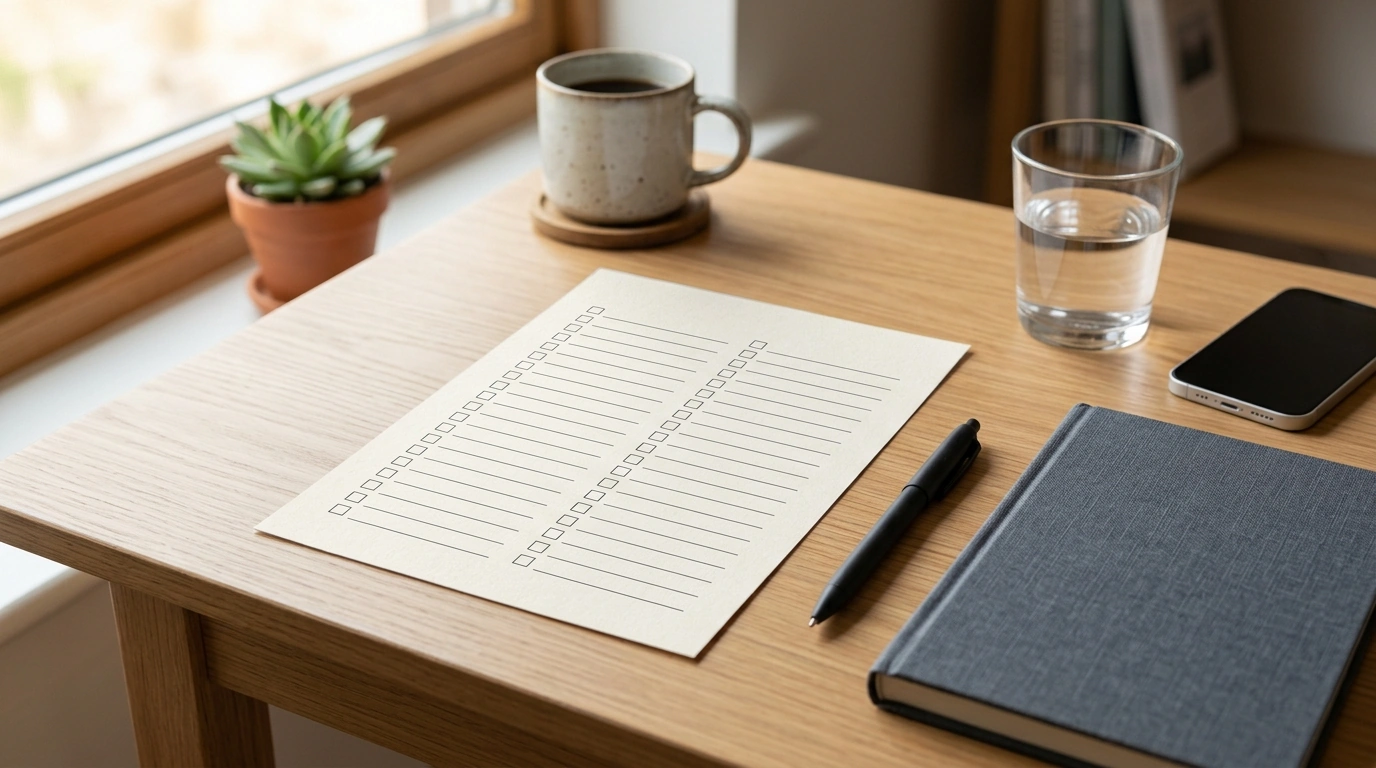
The Daily Discipline Power Upgrade: A Printable Checklist for Stronger Self-Discipline
Building self-discipline is easier when daily choices are made visible, simple, and repeatable. A printable productivity checklist creates a clear “do this next” path for mornings, work blocks, and evenings—reducing decision fatigue and helping small actions compound into consistent follow-through.
Why discipline feels hard even with strong motivation
Self-discipline often breaks down for reasons that have nothing to do with character. Motivation naturally fluctuates, so routines and cues tend to outperform willpower on busy or stressful days. As the day goes on, decision fatigue increases—meaning the brain gets less willing to choose the “hard but important” option. (Harvard Business Review details how decision fatigue affects choices and what helps: How to Manage Decision Fatigue.)
Another common problem is vagueness. Goals like “be more disciplined” don’t translate into action without a concrete next step, a realistic plan, and an environment that makes the good choice easier to start. Even small frictions—phone within reach, unclear priorities, cluttered workspace—can quietly derail follow-through. Tracking progress also matters: it reinforces identity (“I’m someone who follows through”) and makes improvement visible over time. The American Psychological Association notes willpower isn’t just a metaphor; it behaves like a skill that can be supported by structure and strategy (APA: Willpower is more than a metaphor).
What the Daily Discipline Power Upgrade is designed to do
The Daily Discipline Power Upgrade printable productivity checklist (digital download) is built to turn intentions into checkable actions—without making daily planning feel like another project. The core idea is a repeatable workflow: plan → execute → reflect → adjust.
Instead of trying to “do everything,” the checklist helps prioritize high-impact tasks: the few actions that move goals forward. It also supports balanced discipline by including space for health and recovery, reducing the common pattern of overworking followed by burnout. Because it’s a digital download, it can be printed for a binder or clipboard, or annotated on a tablet if that’s easier to keep nearby.
For behavior change to stick, the plan needs to match real life. Stanford’s Behavior Design work (BJ Fogg) emphasizes that behavior happens when motivation, ability, and prompts come together. A visible checklist acts as the prompt, while smaller steps increase ability—so you rely less on fluctuating motivation (Stanford Behavior Design: Fogg Behavior Model overview).
How to use the checklist for a stronger daily routine
Start small and make it repeatable. Choose one “non-negotiable” habit that signals the day has begun (5–10 minutes). Then set a top-3 list: three tasks that would make the day feel successful if completed. Before the inbox or errands take over, time-box the hardest task into a short focus block (25–45 minutes).
During that block, add friction to distractions: silence notifications, move the phone away, or use a site blocker. If phone placement is the issue while you’re moving around (commuting, running errands, or stepping out), a dedicated mount can reduce the “where’s my phone?” loop and keep it out of your hands; the Universal Car Steering Wheel Phone Mount for Safe Navigation is a simple way to create a consistent “phone stays there” rule.
Finally, use an evening reset: a brief review of wins, unfinished tasks, and the first step for tomorrow. Keeping the checklist visible is the secret weapon—desk, fridge, planner cover—so the cue is unavoidable.
Daily flow example (fill using the checklist)
| Time | Checklist focus | Example actions | Why it works |
|---|---|---|---|
| Morning (10–20 min) | Start + clarify | Hydrate, quick tidy, choose top 3, first step written | Reduces cognitive load and creates momentum |
| Deep work block (25–45 min) | Do the hard thing first | One priority task, single tab, timer on | Builds follow-through before distractions rise |
| Midday (5 min) | Reset | Check progress, adjust one task, short walk | Prevents the day from drifting off-plan |
| Afternoon (20–40 min) | Finish + admin | Complete remaining priority, email batch, errands | Keeps shallow work contained |
| Evening (5–10 min) | Reflect + prepare | Mark wins, note blockers, lay out tomorrow’s first step | Closes loops and makes tomorrow easier |
Ways to strengthen self-discipline daily (practical micro-skills)
If a morning anchor helps you keep the routine automatic, pairing the checklist with a quick hygiene habit can work well. A tool like the Triple-Sided Ultra-Fine Soft Bristle Toothbrush for Enhanced Oral Health can make the “start the day” sequence feel frictionless: wake up → brush → check the top 3.
Printable vs. purely digital tracking: choosing what sticks
Who benefits most (and how to tailor it in 5 minutes)
What’s included and how the digital download fits into a routine
If you want a ready-to-use starting point, The Daily Discipline Power Upgrade printable productivity checklist (digital download) is built specifically for that “repeatable, not complicated” rhythm.
Common obstacles and quick fixes
FAQ
How many days does it take to build better discipline with a checklist?
A 7–14 day trial is usually enough to establish consistency and reveal what needs simplifying. Repetition and reducing friction matter more than hitting a specific number of days.
Can a printable checklist work if motivation is low?
Yes—especially when it focuses on tiny first steps and visible cues. On low-motivation days, use a minimum version (one priority + one reset) so you keep continuity without forcing an unrealistic workload.
What’s the best way to print and reuse the pages?
Print multiple copies and keep them on a clipboard or in a binder so you can grab one quickly. For reuse, place a page in a sheet protector and mark it with a dry-erase marker, or annotate the file on a tablet.
Recommended for you



Was this article helpful?
Yes
No









Leave a comment