-
Shop
- Advanced Technologies
- AI Skills for Creators & Freelancers
- AI Client Management
- AI Ethics
- AI Mindset
- AI Tools & Prompts
- AI Writing & Content Creation
- Audio, Voice & Music
- Design & Visual Creation
- Email, Messaging & Communication
- Freelancing & Business
- Marketing, Ads & Conversion
- Productivity, Workflow & Automation
- SEO & Search Optimization
- Social Media Content & Growth
- Strategy, Planning & Analytics
- Video Creation & Editing
- AI Skills Mastery 2026 Collection
- Bathroom
- Best-Sellers
- Car Accessories
- Confidence
- Dating & Social Skills
- Digital Resources
- Easter Products
- Education & Learning
- Family & Parenting
- Fashion
- Fashion Accessories
- Furniture
- Gadgets
- Health & Beauty
- Health & Wellness
- Home & Garden
- Home Electronics
- Home Supplies
- Jewelry
- Kids & Babies
- Kitchen
- Lighting
- Patio, Lawn & Garden
- Personal Growth
- Pet Care
- Pet Supplies
- Pets
- Shoes
- Smart Home Living Guides
- Sport & Outdoors
- Stress Relief & Relaxation
- Super Deals
- TikTok Growth & Monetization Mastery
- Travel
- Travel & Adventure
- Wealth
- Wellness
AI Luxury Room Concepts: Materials, Lighting & Prompts
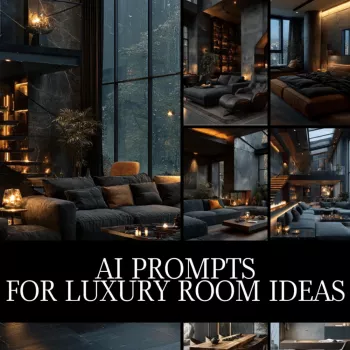
Luxury Room Concepts with AI: A Practical Digital Guide for Interior Designers
High-end interiors depend on clear direction: mood, materials, lighting, and composition. When the vision is strong, even simple furnishings look expensive; when the vision is vague, premium pieces can still feel “off.” A practical digital download can help translate taste into clear, repeatable direction—so designers and homeowners can generate luxury room concepts and décor variations faster, then refine them into cohesive, premium-looking spaces with fewer dead ends.
For platform references and capabilities, see the Midjourney Documentation and the OpenAI Documentation. For foundational guidance on lighting quality and application, the U.S. Department of Energy’s Solid-State Lighting resources are also useful.
What Makes a Space Feel Luxurious
Luxury is rarely about adding more. It’s about editing with confidence, choosing a few high-impact decisions, and letting them read clearly across the room.
- Material hierarchy: Pair statement finishes (stone, brass, lacquer, velvet) with quieter supporting textures that don’t compete.
- Controlled contrast: Balance dark and light, glossy and matte, and protect intentional negative space so focal points can breathe.
- Lighting as architecture: Layer ambient, task, and accent lighting, then use reflective surfaces strategically to amplify glow.
- Proportion and rhythm: Use oversized elements sparingly—one grand sofa, one sculptural pendant, one commanding art piece.
- Cohesion: Repeat 2–4 motifs (curves, fluting, ribbed glass, travertine) across the room for a designed-on-purpose look.
Luxury levers and how to describe them in text inputs
| Design lever | What to specify | Example wording |
|---|---|---|
| Materials | Primary/secondary finishes, texture, sheen | calacatta marble, brushed brass, walnut veneer, boucle upholstery, high-gloss lacquer accents |
| Lighting | Fixture style, temperature, placement, time of day | warm 2700K cove lighting, sculptural pendant, dusk ambiance, soft bounce light |
| Color story | Base + accent + metal tone | warm neutral palette, deep emerald accents, champagne metal details |
| Composition | Camera angle, focal point, symmetry | centered composition, hero fireplace wall, subtle symmetry, wide-angle interior view |
| Style cues | Era, region, craft references | contemporary Parisian, Italian modernism, artisanal plasterwork, refined minimalism |
How the Digital Guide Helps Turn Taste Into Clear Direction
A luxury concept succeeds when it’s specific enough to execute, but flexible enough to explore. A structured digital guide provides repeatable frameworks for describing premium spaces, which makes ideation faster and refinement calmer.
- Structured frameworks for describing luxury rooms with consistent results across concepts.
- Rapid exploration of multiple directions: material swaps, palette shifts, alternative layouts, and styling density.
- Support for both concept creation and refinement—from broad mood to specific finishes and furniture forms.
- Practical value for designers building presentations, homeowners planning renovations, and décor enthusiasts curating a cohesive look.
Using Midjourney for High-End Room Visuals
Premium visuals usually fail for predictable reasons: the architecture is undefined, the material list is too long, or the lighting is generic. A tighter method produces cleaner, more comparable options.
- Start with the envelope: Name the room type and architecture (ceiling height, window style, molding, built-ins) so the “container” reads expensive.
- Add a luxury signature: Choose one hero material and one standout detail (stone slab wall, fluted panels, artisanal plaster) instead of five competing statements.
- Control mood with lighting: Specify warmth (like 2700K), fixture type, and time of day so reflections look intentional.
- Refine with constraints: Keep the palette tight, limit patterns, and repeat one or two shapes (arches, curves, vertical ribbing).
- Iterate cleanly: Change one variable at a time (only metals, only palette, only layout) so comparisons stay meaningful.
Using ChatGPT to Build a Luxury Interior Plan
Once a visual direction is chosen, the fastest path to an elevated result is turning “the vibe” into a set of rules. A planning workflow helps convert a concept into a scope, a palette, and shopping guidance that stays coherent.
- Translate the concept into an actionable scope: furniture list, finish schedule, lighting layers, and accessory rules.
- Create a palette brief: base wall tone, wood tone, stone selection, metal finish, and textile direction.
- Generate sourcing guidance by category: sofa silhouette, rug pile, curtain fullness, and art scale.
- Draft a styling checklist: tray compositions, book stacks, greenery scale, and sculpture placement.
- Write client-facing rationales for why the room feels elevated (material continuity, sightlines, and proportion choices).
Room-by-Room Ideas to Explore
- Living room: Statement stone feature, layered seating, oversized art, and controlled sheen (gloss in small doses).
- Bedroom: Upholstered wall panels, hotel-style bedding layers, soft perimeter lighting, and quiet-luxury color.
- Kitchen: Slab backsplash, integrated appliances, sculptural pendants, and minimalist hardware choices.
- Bathroom: Bookmatched stone, warm metal fixtures, indirect lighting, and spa-like textiles.
- Home office: Rich wood tones, tailored storage, gallery lighting, and a single dramatic accent material.
Common Mistakes That Make ‘Luxury’ Look Cheap
Digital Download Details and Best-Fit Use Cases
Recommended picks (in stock)
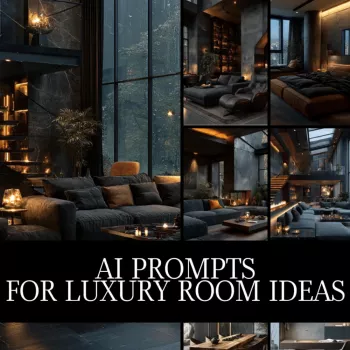
- AI Prompts for Luxury Room Ideas | Digital Download Guide for Interior Design, Midjourney & ChatGPT Prompts, Luxury Home Decor Inspiration
- Armani Exchange Men’s Sneakers (a polished option for studio days and on-site walkthroughs)
- Universal Car Steering Wheel Phone Mount for Safe Navigation (helpful for property visits and sourcing runs)
FAQ
Does this work for both modern and classic luxury styles?
Yes—by swapping architectural cues, material choices, and palette rules, the same workflow can support Italian modern, contemporary minimal, Parisian-inspired, or art deco-leaning spaces.
How can results be made more consistent across multiple images?
Keep a fixed palette and materials list, specify lighting and time of day, repeat a small set of motifs, and change only one variable at a time so iterations remain comparable.
Is this useful if a room already exists and only décor is changing?
Yes—describe the existing architecture and layout first, then generate variations for textiles, lighting fixtures, art scale, and accessory rules without altering the core structure of the room.
Recommended for you


Was this article helpful?
Yes
No









Leave a comment